
Advanced Placement (AP) classes are not the only way students can potentially earn college credit. Juniors and seniors have the opportunity to take dual enrollment and concurrent enrollment classes in order to earn college credit.
In dual enrollment, students take their college classes during the school day, counselor Julie Cler said. However, in concurrent enrollment, college classes are taken outside of school hours, she added.
“When you go directly to a community college, you are earning credit for a class that cannot be used for anything else but that (specific) class,” Cler said. “If you take from a community college directly through dual or concurrent, again, those credits can’t be manipulated. They (can only be used) for that requirement.”
When taking concurrent classes at a community college, students are responsible for providing their own transcripts, Cler said. The counselors double check that the class is accurate and the course completed is the one they signed off on, she added.
“Then we pass it on to the school registrar, and they are the ones that input (it) onto your transcript,” Cler added. “Although when you go off to college, the colleges are going to want an official transcript for any college work you’ve done, even though it shows on your MHS one, they will still want an official one from the college.”
For dual enrollment, the San Jose City College teachers will send their grades to the MHS counselors, Cler said.
“But when you leave us after you graduate and go on to college, you will send your official transcripts for any college coursework you’ve taken,” Cler said.
Senior Angie Dang first heard about dual enrollment through a cousin who has already graduated, she said. She started taking dual enrollment during her junior year, and this is her second year of dual enrollment, Dang added.
“I just took general education, so that includes math, English, science– just everything in general,” Dang said.
Dual enrollment covers fifth and sixth period in her schedule, Dang said. Depending on the course, students can have a class one day and a completely different class the next day, she added.
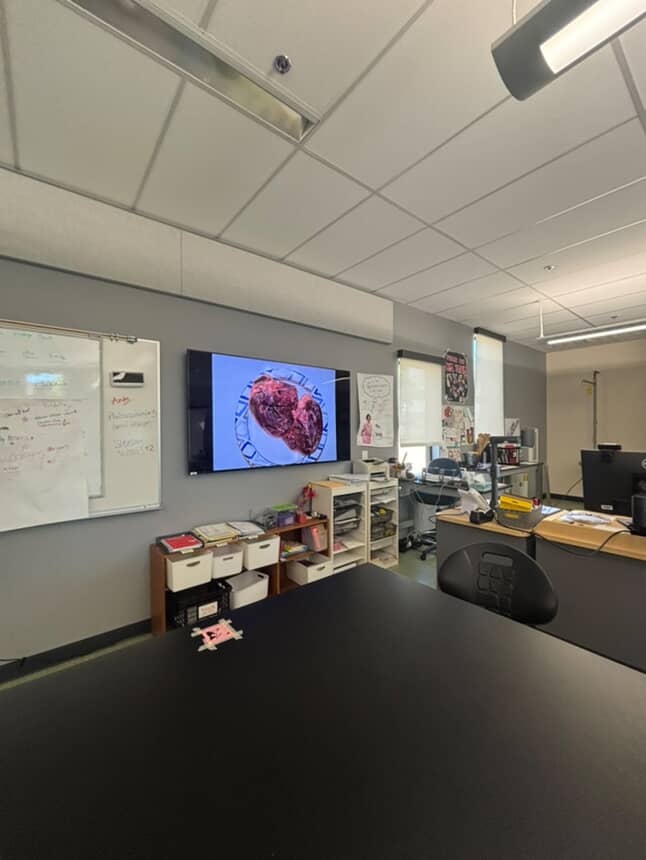
This year, Dang has “the same class, and it’s a science class, so I have one lecture and then a lab the next day,” she said. “Fridays are off, so you get to go home early or stay here (at MHS) for a bit.”
Senior Lina Kimoto is taking a biology concurrent enrollment course at San Jose City College, she said. The course she is taking is a hybrid course, Kimoto added.
“There’s video lectures online, and you watch the lectures, and you take notes, and there’s a quiz, and you just keep doing that,” Kimoto said. “The lab is just in person.”
Kimoto chose her biology college course because she thought it would be helpful for college, she added.
“I want to go into medical fields and bio is everywhere,” Kimoto said. “I wanted to know what I’m getting into. If I don’t like (biology) after taking this class I can change it.”
There is a limit when it comes to taking dual and concurrent enrollment, like any other advanced class, Cler said. At most, a student at MHS can take four advanced courses, and dual enrollment counts as two advanced courses, she added.
“You can have a combination of three either AP or honors within your school day, and then do one concurrent class. If you’re already booked with three APs and an honor, say, in your junior year, there’s no adding on.”
Concurrent enrollment classes aren’t only limited to community colleges nearby, Cler said.
“We’ve had students trying to find certain math classes that they’ve been looking for, from northern California to southern California to central California,” she added. “It just depends. But because the classes are done asynchronously, online, it allows that opportunity to take what you’d like.”
During the summer when concurrent enrollment opens up, students should look for courses that would enrich their learning rather than replace a subject, Cler said.
“What are you interested in that we don’t have here?” Cler added. “Take advantage of that. Colleges love to see that.”
