
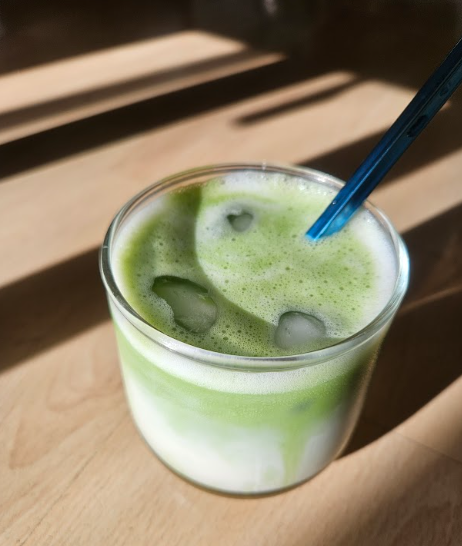
From lattes to soft serve to pastries, the worldwide love for matcha — and agricultural changes in Japan — have led to a global matcha shortage.
Across campus, students can often be seen walking with their matcha drinks in hand. A few have even begun their own student-run small businesses, blending their creative ideas with classic matcha recipes.
For those who are unfamiliar with it, matcha is a powder made by grinding green tea “tencha” leaves from the “Camellia sinensis” plant and is loved for its earthy, umami taste and rich green tone. It was first introduced to Japan by a Buddhist monk, Eichû (743-816), over a millennium ago, and became the center of their traditional tea ceremony, “chanoyu,” according to “The History of Matcha Tea” by Matcha-IRO.
The sudden rise in matcha consumption over the past few years is partly driven by its popularity on social media platforms. On TikTok, “#matcha” has over 15 billion views, according to the article “Why Matcha, Made From Green Tea, is the Drink of the Moment” in The Economist.
Apart from being all over the internet, matcha has attracted individuals looking for a caffeinated drink that can also be beneficial to their health. Matcha contains catechins, a type of antioxidant that is shown to help lower blood pressure and levels of LDL, the “bad” cholesterol, according to “Green Tea Catechins and Blood Pressure,” a study published by the European Journal of Nutrition. Additionally, it has polyphenol, a natural anti-inflammatory compound, and L-theanine, an amino acid that may improve focus, as stated in the article “Matcha: A Look at Possible Health Benefits” by Harvard Health Publishing.
While consumer demand for matcha has undoubtedly increased, production supply has decreased as a result of rising temperatures, reducing harvest sizes in Japan.
Furthermore, high-quality matcha is naturally short in supply because its production requires specific conditions, such as using tea leaves that are grown during spring, according to “Unpacking the Matcha Shortage: An Insightful Look” by the Global Japanese Tea Association. The entire process generally takes about five years from when the crop is planted to when the matcha powder is ready for use.
Unable to produce matcha fast enough to keep up with the demand, Japanese tea brands like Ippodo Tea and Marukyu Koyamaen put out notices about supply shortages; they now restrict the amount of matcha that each customer can buy and have raised prices. In the U.S., the 15% tariff on products imported from Japan has further increased prices.
Matcha was not intended to be sold in bulk; there was never a huge amount of it in the first place, and there is even less after the recent climate changes. Additionally, due to its cultural value, many have been advocating for more respect and awareness when it comes to matcha intake. Nonetheless, more companies and farmers in Japan have begun to put resources towards matcha production to keep up with the global popularity.
Supply is short. Prices are going up. However, matcha has found its way into the hearts of millions, and it doesn’t seem as if the demand will be going down anytime soon.