
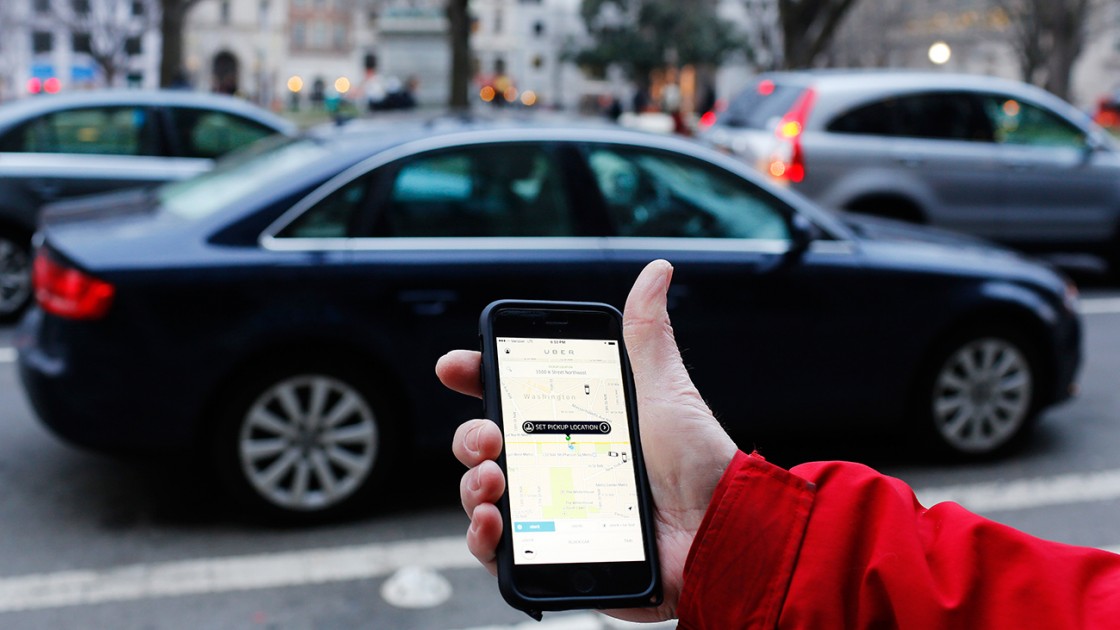
Earlier this year, Tesla’s Robotaxi autonomous cab service was released for the San Francisco Bay Area, touting cheaper and on-demand rides for residents. Currently, driver-based platforms like Uber and Lyft dominate the ride-hailing industry, with Uber bringing in close to $44 billion in revenue just last year, according to Uber’s investor press release for 2024. Both of these services appear to be a quick and easy solution for those looking to make simple trips without access to a vehicle, and I tried both of them to compare the differences.
Uber:
Uber markets itself as a simple cab service, connecting drivers with passengers looking for transportation from one location to another. Their app lets customers select pick up and drop off points, with various options for type of vehicle and driver. Their fare pricing utilizes a dynamic system which accounts for factors such as peak surge hours and length of trip, according to Uber.
I was able to book several trips with various distances, with an average of $5 per mile. One thing with Uber is that you are not guaranteed the same driver every time, so your experience may vary from trip to trip. However, my rides were all relatively similar, with minor differences even across completely different drivers and vehicles.
When booking for myself, I found sedans to be the most common vehicle to be listed on the Uber app. I tested out both long and shorter distance trips, with a ride from our high school to my house pricing in at just under nine dollars. During the actual ride experience, there was nothing exceptionally noteworthy about the end experience. There were small nitpicks, such as making several sharp turns and differing quality of interiors between vehicles, but overall the actual Uber rides got me from point A to B.
One drawback to an Uber was the lack of customization and entertainment. I was limited to scrolling on my phone and listening to my own music in my earbuds, without any options for car-wide sound control. Additionally, adjusting the air conditioning or climate control varied depending on the make and model of vehicle selected.
Robotaxi:
On the other hand, Tesla’s Robotaxi service utilizes their Model Y line of SUVs, which have been modified for this specific program. Potential riders, similar to Uber, use the Robotaxi app to book a ride, but there are no options for different vehicles. The time between ride ordering and pick-up was slightly longer than Uber, with my delay about fifteen minutes long. For a roughly 1 mile ride, I paid just above three dollars.
Due to California’s limitations on autonomous vehicles, there was a safety monitor in the driver’s seat, but he did not interact with the vehicle in any way. Tesla’s Robotaxi fleet utilizes their Full Self Driving (FSD) technology, which takes in video feeds from the onboard cameras and processes them live using the computers built into the vehicle.
One thing that stood out to me while riding in the Robotaxi was just how smooth the driving was. Even on difficult curves and situations with many cars, the computer was able to account for changes immediately. The Robotaxi also drove much like a “perfect” driver would, accelerating and slowing down at a very reasonable rate. I didn’t experience any FSD malfunctions, and the safety monitor did not have to take over at any point.
Contrary to a regular Uber experience, there is a significant amount of customization available for each Robotaxi ride. I was able to link my Apple Music and Spotify accounts for access to the vehicle’s speaker system and also try out some of the gaming options available for the roughly 8 inch passenger side digital screen. These additions helped immerse my experience throughout the ride.
However, where Uber has a wide range of service, the Robotaxi network is limited to a specific Bay Area section. However, I am currently able to reach all the way to Berkeley on a single trip with Robotaxi.
Overall, these ride options were easy methods of transportation for all types of rides. Each service has its inherent flaws and benefits, so it is ultimately up to the end user to decide which platform suits them the most. For a cost effective choice, Tesla Robotaxis take the definite lead, but Uber wins for a nearly unlimited service range.
