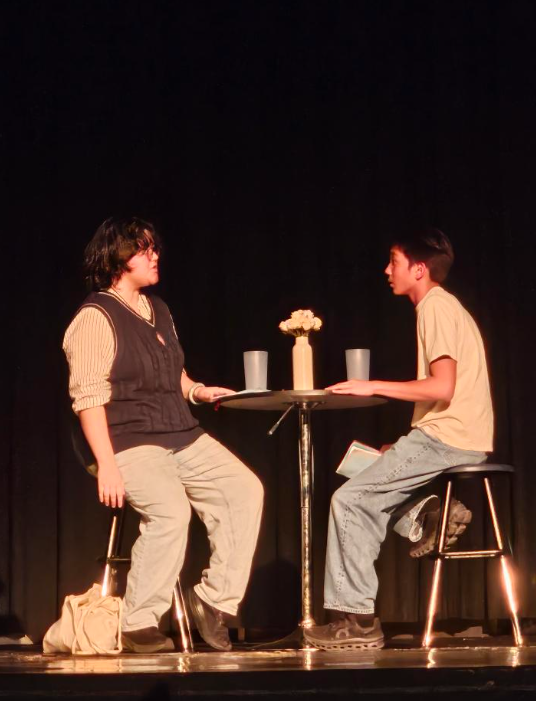
The theater club, Thespian Troupe, and the art and literary magazine club, Arras Periodical, presented, “Deja Vu,” a collection of six individual plays that portrayed love and heartbreak through the warping of time, in the theater on Jan. 23. Each stand-alone play was written by an Arras member and was brought to life by a cast of Thespians.
The Thespian x Arras collaboration has been an annual tradition for the past five years, Arras Periodical Art Vice President Caitlin To said. Common themes in plays from previous years include love and grief, she said. Two years ago, their collaboration, “Hourglass,” was also largely centered around time, similarly to “Deja Vu,” she added.
“There really is a lot of dedication and time put into this,” To said.
The first play, “Another Chance,” written by Uyen Vu, features a conversation between two characters, Desperate and Lover, who have broken up but are still in love with each other. Whenever Desperate attempts to express his feelings, he fails. This leads to him splashing himself with a glass of water, representing time rewinding — another chance. When Lover turns to leave, Desperate grabs the centerpiece of flowers, handing it to Lover while saying, “It’s our anniversary.” They link hands for a moment. The waiter stumbles as he walks by, splashing water on both of them; time rewinds for a final time, and Lover walks off angrily.
Written by Zee Pham, “Over and Over” begins with two lovers, Helen and Vio, walking hand in hand. As they speak to each other, Helen’s co-worker, Harry, stabs him and the stage goes dark. After a few iterations of the scene, each ending with the same outcome, the spotlight shines on the whiteboard and “loop 1607” is written. This time, when Harry appears, Vio stabs him before he can hurt Helen. Despite this, Helen collapses, maybe out of stress or shock or something entirely else. This time Vio lets go, realizing that she can’t change their destiny, and the loop finally ends.
“A Night to Forget,” the third in the series of “Deja Vu” plays, was written by Amy Phan and Asha Balu and is a story about two friends, Yuri and Emi. Yuri is complaining about her classes to Emi, who appears quite distant. When the bell tower tolls, Yuri goes off to class and the stage goes dark. Emi screams offstage. The next scenes begin as the previous started, with Emi alive, and end as the previous finished, with her dead. Many iterations later: when the bell tower tolls, Emi wraps her scarf around Yuri. She promises to be waiting outside of Yuri’s classroom. The stage goes dark, and Emi screams once again. When the scene reopens, there is an empty spot next to Yuri. The play ends with her gently sobbing, scarf in hand.
The three stories that start off “Deja Vu” involve the rewinding of time, which is symbolized differently in each of the plays, whether it is through the splashing of the water, the stabbing, or the tolling of the bell. The plays evoke a sense of “deja vu” or the feeling that a situation occurring in the present timeline mirrors a memory from the past.
“An Untitled Favor” by Artemis Kwok, “I Don’t Want to Remember” by Nellie Rathod Banuelos, and “If the Stars Were Rewritten” by Raaghavi Kalluri were the three other plays featured in “Deja Vu.” They emphasized themes surrounding human relationships, grief, and love over the course of time.
Through inspirations, like Edgar Allen Poe’s “Annabel Lee,” as well as her own imagination, Arras Periodical playwright Raaghavi Kalluri was able to “weave a creative story together,” she said.
“I think one of the things about writing a play that contrasts from writing a story is that in a story, you have a narrative and you can explain things in text that are not spoken,” Kalluri said. “In a play, without reading the script, you need to be able to help the audience convey (grasp) the message.”
Part of what was so beautiful about the play was the actors and directors interpreting her script in their “own unique way,” Kalluri said.
“It’s one thing to write a script, a whole other thing to perform it,” Kalluri said. “Honestly, the way they did it, I couldn’t have asked for better.”
Apart from actors and directors, many Thespians volunteered to help out backstage, Thespian Troupe President Mazaria Aldrich said. Some of them focus on tech-related aspects of theater, such as the lighting, audio, and spotlight, she added.
“Writers have a … specific vision on how they want their scripts to come to life on stage, so I want to give them that privilege first before moving on to having directors pick,” Aldrich said.
In the summer, Arras officers began brainstorming themes that club members would vote on when the school year started, To said. They also let members sign up to be playwrights for the show if they are interested, she added.
One of the tasks that To worked on was making the digital playbill which has “information about the play, the cast list, and summaries of each play so it’s a little easier to follow,” To said.
Arras also began advertising the play by means such as Instagram and the morning announcements in the weeks leading up to “Deja Vu.” They sold over 170 tickets — some in advance at their stand during Clog Rush and some by the theater door on the day of the show.
In preparation for the play, the Thespian Troupe held auditions and rehearsals, Adrich said. The most important part of planning “Deja Vu,” however, was ensuring clear communication between everyone involved in the play — the writers, the Arras officers, the actors, the directors, the tech, and the backstage crew, she said.
“It’s a whole community that you have to keep in touch (with each other),” Aldrich added.
She found a passion for theater ever since she became a part of it during freshman year, Aldrich said.
“When I went to my first production as a freshman, I realized that this is what I want to do forever and ever,” Aldrich said. “I want to pass on that passion to everybody else … who comes to experience theater.”
In order for the play to come together, a variety of skillsets had to merge, like art, creative writing, and drama.
Art is an outlet for To — a place to put out ideas that are important to her and explore things that she is interested in, To said.
“I think art to me is all about expression,” To said.
Creative writing has been a huge part of Kalluri’s life since she started doing it in elementary school, she said. She joined the Arras Periodical in her freshman year of high school and is currently an in-house editor for the magazine, she said.
“Even though I have won awards and titles with it (writing), that’s not all that it means to me,” Kalluri said. “Ultimately, it’s my passion. I hope I always do it.”
In comparison to other subjects, such as math, there is no definite “right way” when it comes to writing, Kalluri said.
“Everyone has different writing styles, just like everyone has different tastes in writing,” Kalluri said. “In the end, I think the best thing is to see the fruits of your labor and to see how you can create a beautiful piece if you put your heart and mind into it.”