
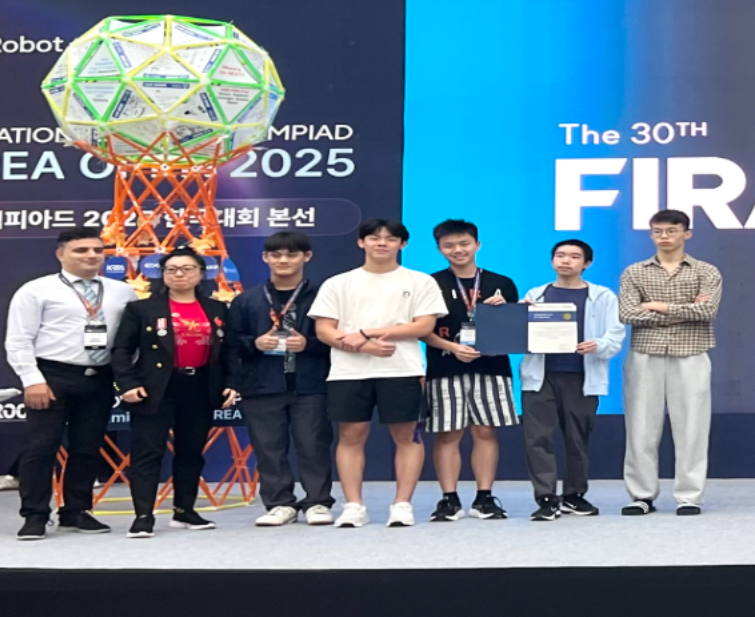
Senior Henry Ping won second place at the Federation of International Robot-Soccer Association (FIRA)’s RoboWorld Cup competition in Daegu, South Korea, held Aug. 11-15, he said. This international robotics event featured students from around the globe, testing their skills in robotics, artificial intelligence, and drone flight, according to FIRA’s website.
The competition featured several categories of robotics, but the specific section in which Henry Ping competed challenged participants to program drones that could pass through gates and obstacles on their own, he said. He represented the U.S. while also working in tandem alongside a Canadian team, he added.
“I chose to take part mainly because of my passion,” Henry Ping said. “I also wanted to stand out because a lot of people in school here also do robotics. Most of the college applicants have that, but don’t have foreign competitions on their resume.”
Although the event lasted only a week, preparation for this competition took several months, Henry Ping said. He spent hours each day after school coding, testing simulations, and fine-tuning his drone to go through obstacles and judge proper distances while flying, he added.
“At first, I thought this competition was just another hassle,” Henry Ping said. “But in the end, I realized I learned a lot of new things and expanded my knowledge and skillset.”
Henry Ping spent more than half a year preparing for this event, his father John Ping said. Henry often stayed up late to work on his drone and to refine his code, he said. Despite training at home and having a smaller space to work with, Henry still made the most of what he had to test his drone’s mobility and avoid errors such as drifting, he said.
“He’s very dedicated, very hard working, and also a team player as well,” John Ping said. “He has to persevere and be on his own while also facing challenges, even with the pressure.”
Henry Ping overcame several daunting obstacles during the competition as well, Henry Ping said. One of the main issues was troubleshooting, he said. Most notably, the drone’s camera had functioned differently than it did during testing back in the United States and needed fixing, Henry Ping added.
“We spent the first four days in bottom place,” Henry Ping said. “On the night of the fourth day, we stayed overnight trying to fix it. In the end, we managed to rectify the issue and come back.”
Senior Gurmukh Minhas, a close friend of Henry Ping for years, wasn’t surprised by Henry’s success in the competition, Minhas said. Henry Ping is someone who dedicates himself to whatever he does, and as a result, inspires others to work harder, he added.
“He submerged himself a lot in his work,” Minhas said. “Sometimes I just sit down and think, ‘What would Henry Ping do today that I could do better?’ I see him as a role model.”
The experience gave Henry valuable life lessons about resilience and optimism that go far beyond the competition, John Ping said. He hopes that Henry’s story also goes on to encourage other students to pursue their passions and interests with determination, John Ping added.
“If you have a passion, try hard to pursue it,” John Ping said. “Don’t be afraid of challenges. Be adaptive, be optimistic, and turn the knowledge into the things you want to create.”
Henry Ping hopes his own story will motivate other students to take risks and follow their passions or go after what excites them, even when it may feel difficult or unfamiliar, Ping said.
“Just go for it,” Henry Ping said. “Take yourself out of your comfort zone and also form connections because these are the people that in the future might help you land a job. Even if it turns out bad, you’ll learn something.”
