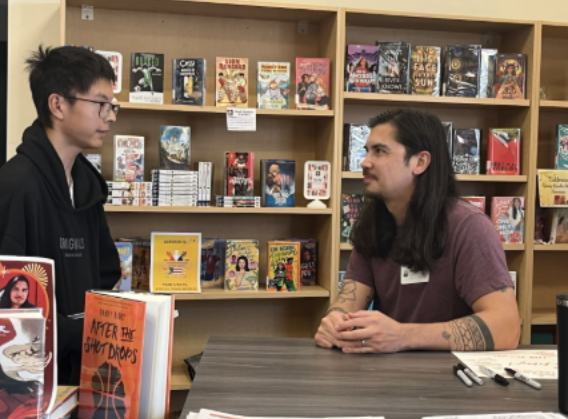
Award-winning Filipino-American author Randy Ribay visited MHS on Oct. 20 for an assembly and a meet-and-greet with students and staff. Numerous students and English classes attended the theater during third period to hear Ribay speak about his novels, his writing process, and how he became an author. After the assembly, Ribay attended a student meet-n-greet during fourth period in the library, where students and teachers had the chance to speak to Ribay and get their books signed.
Librarian Mia Gittlen introduced Ribay on stage at the assembly, and the crowd applauded as he walked onto the stage. Ribay addressed the crowd, as students snapped pictures of the author.
“Everywhere I go, my name gets mispronounced, but I figure if it’s going to be pronounced correctly, it’s going to be here in Milpitas, so thank you for that,” Ribay said in the assembly.
Ribay went over his literary body of work, which includes “Patron Saints of Nothing”, “Avatar, the Last Airbender: The Reckoning of Roku”, and his latest novel, “Everything We Never Had.”
Growing up in a half-Filipino, half-American family, Ribay grew up loving stories, but was encouraged by his family to pursue engineering and join Air Force ROTC, he said during the assembly.
“I did the engineering thing for about a year, and I was pretty miserable,” Ribay said. “I was like, “This is not what I want to do with my life.’”
Later, in college, he switched his major to English, much to his parents’ horror, Ribay said. Growing up in the Midwest, he was one of the few Filipino students in his community, he said. He was exposed to Filipino and Filipino-American writers in college, along with numerous other writers who were people of color, including Chinua Achebe and Toni Morrison, he added.
“As I read these authors, these Filipino and Filipino-American authors, I saw that books could do so much more than just be entertaining,” Ribay said. “I saw that they could be beautiful.”
After college, he went on to be an English teacher for 16 years before choosing to become an author himself, Ribay said.
Some books that get banned include topics like grief and death, Ribay said. He added that “Patron Saints of Nothing” has been challenged in different parts of the U.S.
“These are the kinds of books that are getting disproportionately banned by these organizations, these individuals who are going to their school boards and complaining these books should be taken off shelves,” Ribay said. “If you believe, as I believe, that our stories matter, we need stories that can be mirrors for people or windows for people. It’s important that we’re fighting for those stories.”
After the assembly concluded with Ribay taking questions from students, Ribay and some students headed to the library for a meet-and-greet. Numerous students and some teachers lined up to speak to Ribay and get their copies of his books signed. At the end of the event, the students and teachers present took a photo with Ribay in front of a sign hand-painted by Pilipinx United Student Organization (PUSO).
It was an honor to speak at a school in his region, Ribay said in an interview. Ribay was especially excited to speak at MHS, as Seafood City Milpitas is featured in his upcoming novel, he said.
“The story is set in the South Bay,” Ribay said. “It’s about a brother and sister and mananagal, which is a kind of Filipino vampire that can detach at the waist and fly about. It features different spots in the South Bay, where there’s a strong Filipino-American presence, and so I had to include Milpitas.”
Gittlen contacted Ribay through his publisher, she said. Around 50 students attended the meet and greet, she added. She had seen Ribay at several conferences last year and was able to receive copies of his novels for the school library, she added.
“I had actually asked him about school visits, and he had mentioned to me twice at two different conferences about his upcoming book having a scene that takes place in Milpitas”, Gittlen said.
To have a successful author speak to so many students who are artists, writers, and creators is very inspiring, Gittlen said.
“Seeing Mr. Ribay interact with the students was just wonderful,” Gittlen said. “I think that’s what is most important to me, that students have these opportunities to connect.”
Gittlen is a quarter Filipino, and wasn’t raised much around the culture, she said.
“When I look at somebody like Randy Ribay, who’s had more Filipino representation in his family, but also has done a lot of work to read the stories and do research, it also inspires me to do more to learn more about my own culture,” Gittlen said.
Leia Ramos, vice president of PUSO, said that when Ribay signed books, he wrote the phrase “isang bagsak.” Ramos thought it was interesting because PUSO says the phrase at the end of all their meetings.
“It’s about unity,” Ramos said. “‘Isang’ means ‘one.’ It originates from the Delano Manong, the grape strikes by Filipino-American farmers. Together, it means ‘one down’ or ‘one fall’. If one falls, we all fall.”
Sophomore Ciello Valle said that she had been trying to get her hands on one of Ribay’s books and was looking forward to reading his work in her English class.
“Especially since Randy Ribay is Filipino, I feel like I’ll have a connection and a sense of belonging when I read it,” Valle said. “You would definitely learn more about how Filipino households are, how they operate, and how the culture is.”
Ribay couldn’t believe that “Patron Saints of Nothing” had the wide reach that it did, he said. “Patron Saints of Nothing” speaks heavily about the drug war in the Philippines under Rodrigo Duterte’s presidency, Ribay said.
“I hope it piques that curiosity and piques that sense of responsibility, that we need to pay attention to what’s going on, and we need to try to do what we can in regards to making the world a better place,” Ribay said.
Readers can analyze a story from different perspectives, such as race or sexuality, Ribay said.
“There’s all these different ways of looking at what a story is and what that story teaches us about the person or the time and place or the society that produced that book,” Ribay said. “It’s an additional way of looking at it, other than just as a piece of art.”
Stories are a vehicle for how to think about the world, Ribay said. “Patron Saints of Nothing,” for example, is meant to be entertaining, but readers should develop an understanding of how things, like the drug war, happen in the world, and how to respond, he said.
“For a lot of people, a story speaks to us in a different way,” Ribay said. “It makes us understand the reality of what actually happens, or the human effect of what’s actually happening. When we encounter a story, it teaches us how to think about the world, how to think about our own feelings and the feelings of other people.”