
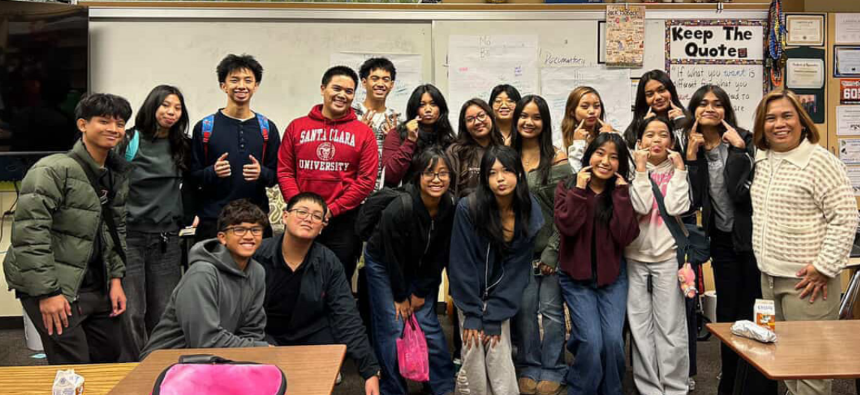
This year is the third consecutive year where the Philipinx United Student Organization (PUSO) has done a student exchange program with Milpitas’s sister city, Dagupan, in the Philippines, PUSO advisor Tonichi Lorenzana said.
The program sends Filipino students who are leaders of their community, along with other adult community officials, Lorenzana said. Part of the reason is to see how the local government and school system works in Milpitas, as schools run differently in different countries, he added.
“It’s getting insight into what we do here in Milpitas, and what are things that they can adopt and change back home,” Lorenzana said. “I think it’d be worthwhile for students and educated people from Milpitas to see the same thing, to see what is going on in other parts of the world and how they use technology, or what teaching programs they have.”
The purpose of the program was to exchange ideas between the Filipino and American education systems, as they are different from one another, PUSO president Elise Mina said.
“For example, they have the student or the teachers come to each of their classrooms,” Mina said. “In America, we have all the students walking around campus from class to class.”
Unlike MHS, exchange student Andi Reyna’s high school has electives geared more towards academic subjects like biotechnology and trigonometry, she said. She enjoyed the fact that MHS had more subjects geared towards the arts, she added.
“We go to a science high school,” Reyna said. “So it’s more focused on science, math and just STEM overall.”
There are differences between the language and phrases used in English between America and the Philippines, Reyna said.
“When I went to the other campus, this girl was going to have a birthday tomorrow, so I said, ‘Advanced happy birthday,’” Reyna said. “Then, I learned that nobody says that here. You guys say, ‘Happy early birthday.’”
The technology at MHS is much more advanced than at their school, exchange student Clarence Aquino said.
“For example, the TVs in the room, compared to our TVs, (are) much bigger here,” Aquino said. “Here it’s more technologically advanced, since they give you laptops and MacBooks. Also, you guys have free Wi-Fi for the guests. Unlike for us, our Wi-Fi in the school, you have to figure out the password of the Wi-Fi.”
Aquino preferred the culture of American schools compared to the ones in the Philippines, he said.
“Unlike in our school, if they’re (students) older than you, it’s hard to talk to them because they think they’re more superior or something,” Aquino said. “But here, you could approach anyone. It’s more friendlier over here.”
Aquino is thinking about coming back to the U.S. for future studies, he said.
“When I went into the Innovation school, I really liked how their system works,” he said. “I prefer it there, because it’s less crowded.”
Hosting a foreign student and showing them around campus was an eye-opening experience, Mina said.
“I really got to think about how I’m perceived as an elder,” Mina said. “How they treated me was kind of like how a student would treat a teacher. I thought that was very interesting, and that made me think about how I respect my elders, and how the culture here is just so different.”
As president, Mina coordinated where the exchange students went and which of the officers they would partner with, she said.
The PUSO officers’ job was “just making sure they had a good time here, and that they learned all about the typical American education experience,” Mina said.
Lorenzana focused mainly on communication and outreach within the school and district as the advisor, he said.
“I coordinated with Ms. Kim over at the Innovation Campus because they want to see the Innovation Campus,” Lorenzana said. “Then, I talked to Ms. Scott, who is the principal at the Middle College, so that we can take students over and they can observe the Middle College, just to see the different kinds of high school options that are available.”
It’s cool how students from different backgrounds get to interact with one another during the exchange, and learn more about the other person’s culture, Lorenzana said.
“(MHS) students can learn what’s going on in the Philippines, and then our students from the Philippines can learn how we do school and how the interactions are with teachers and fellow people,” Lorenzana said.
One thing Lorenzana appreciates about the exchange program is all the support received from teachers, the district, and the city of Milpitas itself, he said.
“The students are obviously very much engaged and they want to be good hosts,” Lorenzana said. “But then to have the support of the city officials and everyone else, it just adds more to it. It makes it feel more of an event and not just like a little thing that happens once a year.”
