
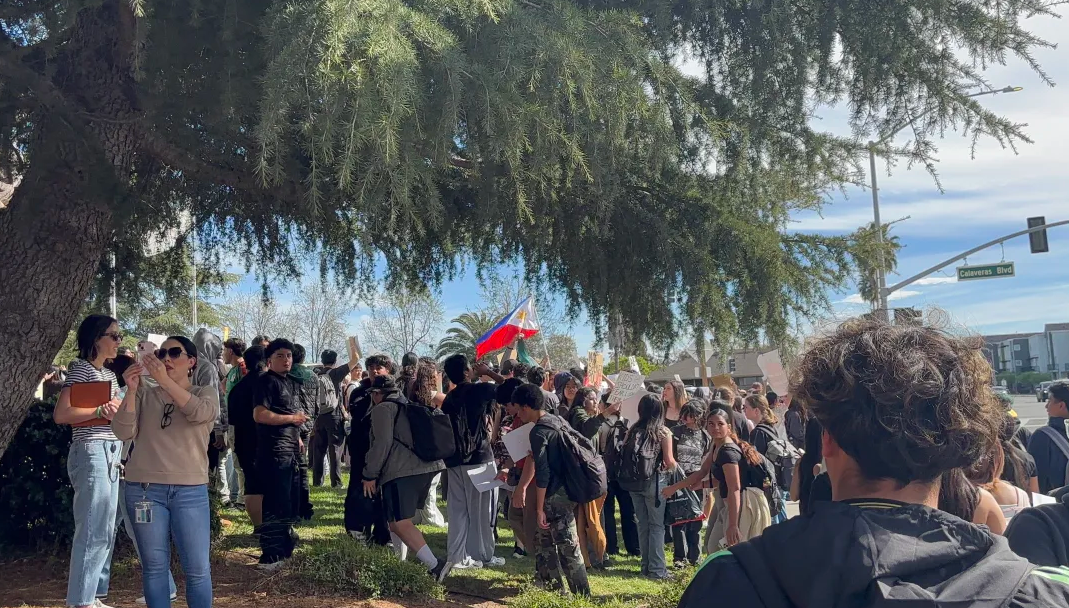
On Friday, Feb. 27, alongside many other MHS students, I participated in the walkout against ICE. I would like to state, firstly, it is not my intention to offend, reproach, or personally target anyone with my writing. I do not have that right. I commend the organizers of the walkout for stepping up in the face of political turmoil, assuming leadership, and working so hard to successfully unite and inspire a large portion of the student body.
The turnout was incredible—from what I saw, at least 150 students showed up and showed out, carrying handmade signs and flags and chanting at the tops of their lungs. Participants walked approximately a mile and a half from the main campus to City Hall, and the event lasted well over two hours. The procession was overseen by a number of Milpitas police officers, who assisted with traffic safety.
However, to me, the walkout felt off since the first announcement. Rumors circulated wildly—some people thought immigration enforcement would be present at City Hall, ready to arrest undocumented students, while others believed secret teams of government snipers were planning to blow students’ heads off from nearby vantage points.
In the wake of these unfounded rumors, strange, counterintuitive decisions were made by the organizers of the walkout. A police escort was secured for an act meant to defy the law, and the permission of school officials was obtained for an act aimed at disrupting the school’s operation.
I question whether these negotiations were necessary. Our walkout became a school-sanctioned activity supervised by law enforcement officers. The way I see it, an act of activism should always be an act of sacrifice wherein participants make a conscious choice to trade safety and routine for political impact and disruption.
We lost the plot by asking cops to babysit us, advertising free food at the protest, and imploring Principal Wohlman to excuse our absences. It almost seemed as though we were more concerned about our ability to cross a street, our short-term hunger, and our attendance rate than the actual issue at hand: getting immigration enforcement out of our community.
Ultimately, the organizers of the walkout decided to push back the date of the event from the beginning of February to the end of the month. That delay, even if unintentional, made us late to the party. Dozens of other Bay Area high schools had organized and staged their walkouts a full month prior, on Jan. 30—a nationally designated shutdown day endorsed by thousands of activist organizations across the United States.
If we had walked out on Jan. 30 or even within that same week, we could have multiplied our social impact by the number of other high schools that also walked out. There’s power in numbers—the more students walk out at the same time, the more attention we draw. But since we were so late, Milpitas High stood alone and the impact was muted.
Furthermore, when we decided to postpone our political demonstration, the rest of the country didn’t wait for us to catch up. In fact, ICE withdrew operations from Minneapolis faster than we managed to get our walkout organized. If one of our goals was to attract attention from the media and the community, we missed the golden window where the actions of ICE were front-page news and a huge topic of conversation.
Moreover, I found it odd that our demonstration started at 1:20 p.m., while many other Bay Area schools chose to walk out in the morning. This meant that participating MHS students missed two classes—maximum. Personally, I only missed one.
I don’t know if the organizers decided on the starting time or if administration decreed it. However, a brief glance at California law suggests that it was likely the latter.
According to the California Department of Education (CDE): “If students are scheduled for at least the minimum school day, attend any portion of that day under the immediate supervision of a certificated employee while engaged in required educational activities – and then walk out – the LEA (local educational agency) may still claim attendance for apportionment.” Since the CDE also states that the minimum school day in California for grades 9-12 is only 240 minutes, that means our school didn’t lose any money.
To reiterate, I don’t know who had the final say on the starting time of the walkout. But if—hypothetically—we allowed school administration to dictate the terms of our walkout so that they could keep their funding, can we really call the walkout “student-led”? A shorter demonstration is almost always a less impactful one.
Regardless, we now have the unique opportunity to increase the effectiveness of tomorrow’s student-led political efforts by learning from yesterday’s successes and failures.
I believe that, going forward, research and self-education should take precedence. Before organizing any act of civil disobedience, students should have a solid, foundational understanding of how the specific act works and what needs to be done to maximize its impact.
For example, armed with specific knowledge of how walkouts work, organizers of future demonstrations might be able to focus on the true objective—escalating disruption and garnering attention from as many people as possible—rather than trying to please school officials or hungry participants.
I would like to conclude by reiterating my respect for the organizers of the walkout. Any action is better than no action, and in many respects, the walkout was a success. It visibly raised public awareness of ICE’s transgressions, and I have no doubt that this walkout inspired many students and members of the Milpitas community to continue expressing themselves politically in the future.
Nevertheless, there is always room for improvement.