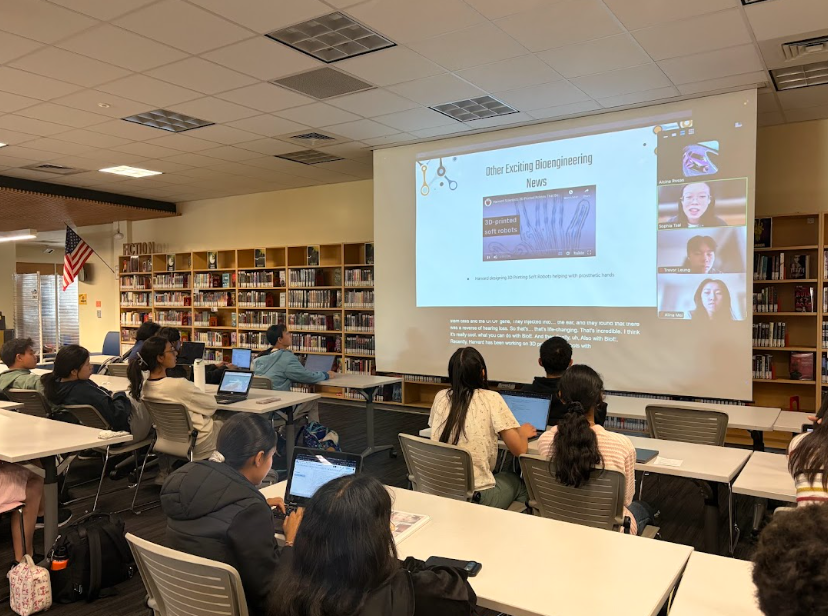
The UC Berkeley Bioengineering Honor Society (BioEHS) introduced bioengineering and possible career pathways in the field to a group of around twenty students in a live, online presentation in the library on Mar. 11.
Bioengineering is the intersection of many fields, including but not limited to biology, chemistry, material science, mechanical engineering, medical statistics, and physics, Trevor Leung, one of the presenters and a third-year undergraduate, said.
“UC Berkeley defines bioengineering as a discipline that applies engineering principles of design and analysis to biological systems and biomedical technologies,” Leung said.
BioEHS recognizes UC Berkeley undergraduate students majoring in bioengineering who’ve “demonstrated exceptional academic talent and abilities in their field” and provides them with opportunities that will “benefit themselves and the community,” according to their website.
The Outreach Committee “organizes school visits, plans events on Berkeley’s campus, and hosts talks online to educate future engineers about the field of bioengineering, empowering them to explore their interests further,” according to the website.
The presentation exposed freshman Aimee Luong to other career paths to consider that she previously hadn’t known about, she said.
“I always thought, ‘If I do biology or biomedical, I can only really go into being a doctor and literally only being a doctor,’ but now that I’ve seen it, I’m like, ‘Oh, I can be developing technologies,’” Luong said. “So it’s not only one certain path. It broadened my horizons.”
Some career paths for bioengineering majors include going into pre-health, industry, academia, startups, and pre-law or public policy, Sophia Tsai, a second-year undergraduate, said in the presentation.
“BioE is composed of a lot of different topics, so this is only a small sliver of what you can go into,” Tsai said.
There are four main concentrations of bioengineering: biomedical devices, biomedical imaging, cell and tissue engineering, and synthetic and computational biology, according to the slides they presented.
Undergraduates aren’t expected to commit to a particular concentration, Leung said. The concentrations are simply categories to help students think about and explore more specific areas that they could pursue in their career or in graduate school, he said.
The biomedical devices concentration has many applications, including developing microfluidics, bionanotechnology, and drug delivery systems, according to the slides. Biomedical imaging, which focuses on imaging for diagnostic and therapeutic purposes, is a more specific concentration that can fall under biomedical devices, Leung said.
“There are a lot of really cool classes in this field (biomedical devices), like BioE 104 — I took that one a year ago,” Leung said. “And there’s a bunch of other different classes about different devices, imaging, microdevices. Super cool concentration. Super broad.”
The cell and tissue engineering concentration encompasses areas such as transplantation, stem cell therapies, and drug development, Alina Mei, another presenter and a first-year undergraduate, said.
“The very last concentration out there is synthetic and computational biology, which focuses on designing new biological systems and functions,” Mei said.
To finish off the presentation, Tsai talked about some recent news in the bioengineering field, such as hearing aids designed to be nearly invisible, a gene therapy that reverses hearing loss, and 3D printed soft robots with prosthetic hands that can bend into different forms.
There was an opportunity for students to ask questions to the presenters, but no one had any, and finally, there was a short case study that got students to think about how bioengineering could be applied to potential real-life situations.
Overall, the presentation was informative and detailed; many students took notes, and almost everyone seemed engaged throughout.
The examples of recent bioengineering work that have contributed to technological advancements were an especially memorable part of the presentation, freshman Chaitra Annadi said.
“I think it (the presentation) was really cool, and it also really opened my eyes to the career paths in bioengineering,” Annadi said.