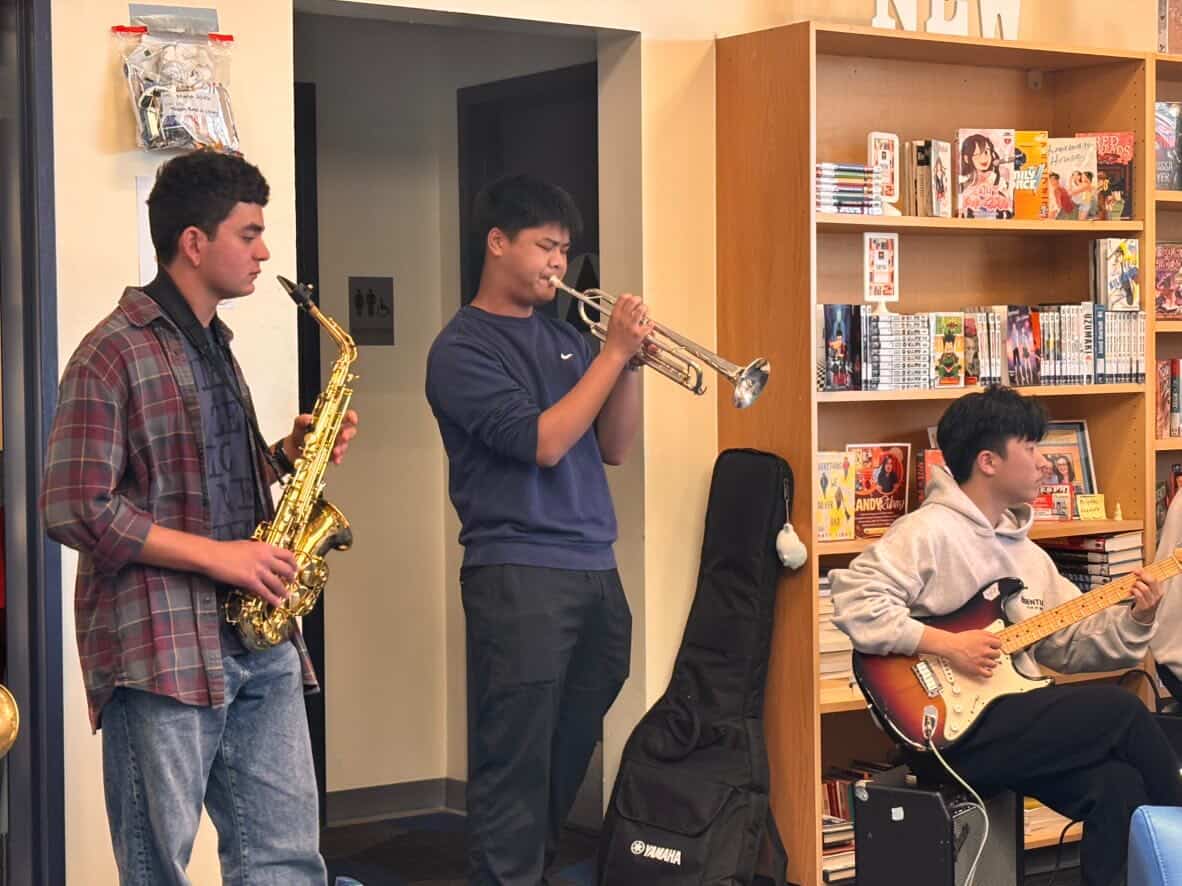
The first ever Tiny Desk concert at MHS, an intimate live musical performance, took place in the library on April 29. Jazz musicians from the music department’s Jazz Combo performed for dozens of students, faculty and staff. Each person present at the event was either studying or enjoying the music. The Jazz Combo performed three songs.
Senior Alex Marquez was the student that played drumset for each song at the Tiny Desk concert, Marquez said. The Jazz Combo musicians chose three songs to play at Tiny Desk, he added.
“One of our songs was ‘Red Clay,’ a song written by Freddie Hubbard,” Marquez said. “We chose the song because, personally, I just really liked the whole arrangement. I thought it was a really cool song. I think it fit well with our instrumentation.”
The second song that they performed was a piece named “Argonaut,” which was composed by a student named Amy McDonald, Senior Joseph Yim said.
“We went to one of their festivals,” Yim said. “We saw their live performance, and we thought it was cool, so we just decided to play it.”
The last song that they performed was “Backyard Groove” by Kenny Garret, Marquez said.
“I just chose that one because I just thought it also had a good groove,” Marquez said. “I thought it was a great fun piece for the crowd and us to enjoy.”
During the performance, the performers improvised some of their parts, mainly during their solos, Marquez said. When another performer decides to change up the melody, the others follow along, he added.
“So a lot of jazz combos, usually they’ll be given a chart, a jazz chart, and it’ll have chords and a set rhythm that you have to follow, but you mainly take into consideration while playing through it, but definitely in that process of playing that arrangement, you could definitely take liberties and improvise your weight, like through solos, or maybe changing the melody a little bit,” Marquez said.
Improvising is like feeling the melody and going with the flow, Yim said.
In order to improvise, “you have to have prior knowledge on how to practice your skills and be ready, so that prior knowledge, or the practice, comes out during performance,” Yim said.
The Tiny Desk was a great way for the musicians to be able to connect to some people at MHS who weren’t as involved in the music program in general, Marquez said.
“I thought it was just really fun to be able to bring music into somewhere where it’s quiet regularly,” Marquez said.
The idea of holding the first Tiny Desk at MHS first came from librarian Mia Gittlen, who later spoke to Music Director Kylie Ward about her idea, Gittlen said. The Tiny Desk was loosely modeled after NPR Music’s Tiny Desk series, she added.
The Tiny Desk event aimed at “spotlighting the really amazing musicians and giving them a platform and something for students, faculty, and staff to enjoy during lunch,” Gittlen said.
The music played at the event created a beautiful atmosphere in the library and attracted people that normally didn’t stay there, Gittlen said. Some staff members were surprised about the event, as they hadn’t seen something like that in the library before, she added.
“There were lots of people that came in, poked their heads in for a moment, and listened for a little bit,” Gittlen said. “There were a lot of people that came through that were not the regular folks that hang out in the library during lunch.”
Ward liked the idea of the event as she found it really interesting and since she wanted to give her students more performing opportunities, Ward said.
“One thing I like about the Tiny Desk concerts in general is that they’re usually acoustic, like you only have so much space in your little desk to make music, so it’s usually stripped down,” Ward said. “For me, it feels very authentic to what music used to be and what it still is for some people.”
Ward selected her most experienced students to perform at the Tiny Desk concert, she said. She allowed them to take charge of their performance, so other than helping her students with the logistics or just giving them advice, the performance was entirely student-led, she added.
“My students got together during their own time and decided what music they’d want to play, and then pretty much the week leading up to the concert, they were able to use some rehearsal time in class to work as a group,” Ward said. “We have some large practice rooms in the new building, so they rehearsed, talked about what they wanted to change and improve and then made that happen.”