
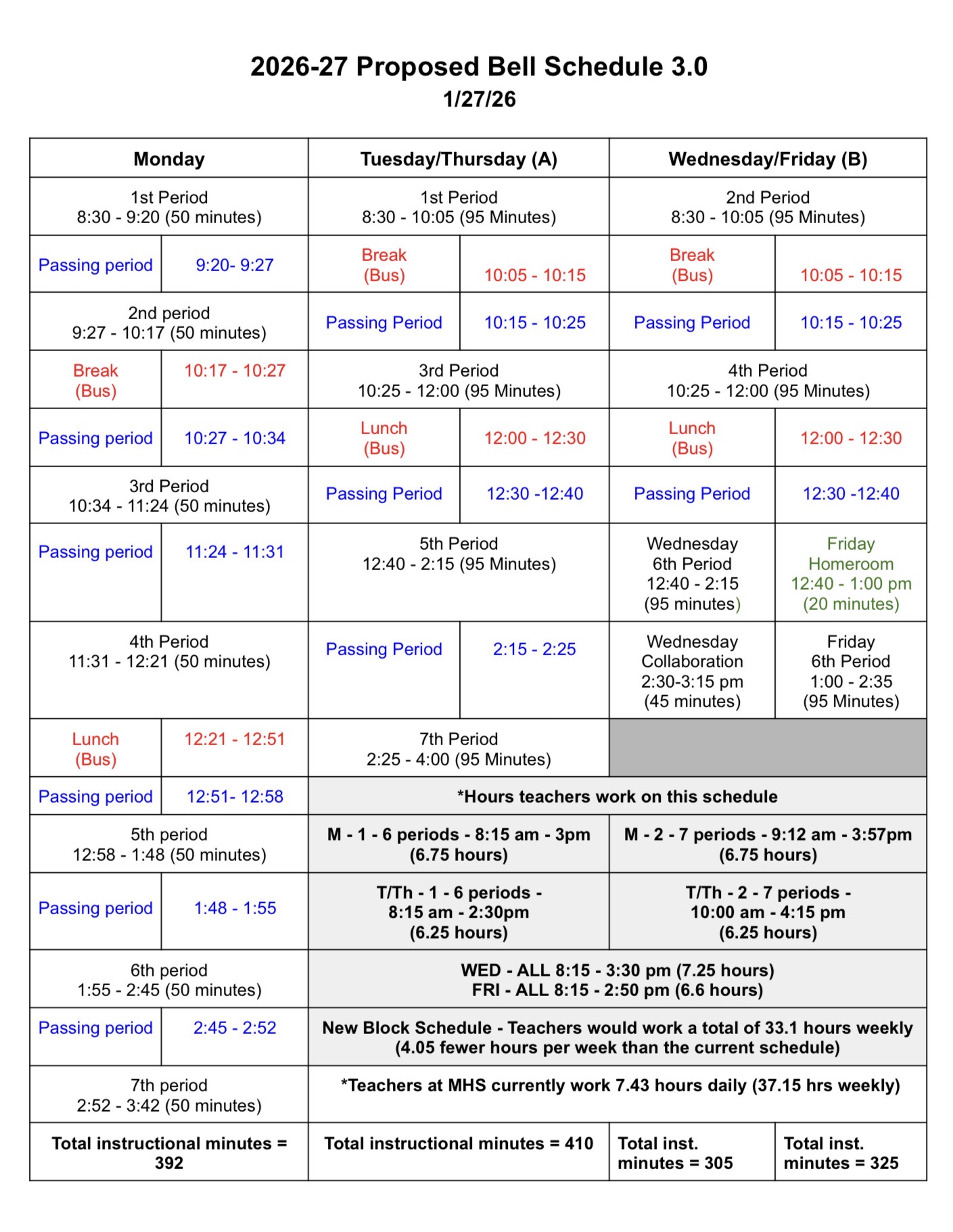
To accommodate the new bus schedule, among other reasons, administration is proposing and examining the option to switch the main campus to a block schedule, Assistant Principal Dawnel Sonntag said.
The introduction of the bus system between the main campus and extension is part of an effort to provide students with access to facilities and course offerings at both sites, Sonntag said. The bus system was further intended to balance class sizes between the two campuses, she added.
“Unfortunately, because the schedules (at the main campus and the extension) are not the same, the buses go at weird times, so it has made it really difficult to have all classes be of equal sizes,” Sonntag said. “The hope is that we can have aligned bell schedules. If we have an aligned bell schedule, then it should be easier to balance.”
The long-term goal for the extension campus is to be integrated so seamlessly into the main campus that they function as one big campus, Sonntag said.
“It just happens to be 2.2 miles away,” she added.
There are now over 350 students with classes at the extension at the Innovation Campus, which is significantly more than last year, when there were less than 150, Sonntag said.
Starting this school year, students no longer have a choice on whether or not they would like to attend the Innovation Campus, Sonntag said.
“Previously, because Innovation was like its own little program, parents and students had to choose it,” she said. “This year and going forward, it is just a part of our regular school. So while some students chose classes that are there — for instance, maybe they chose robotics — other students are there for math, history, and English. It’s not about what classes you choose; it’s just what works with the schedule and where we’re able to make the best balance possible.”
Busing is not going away, Sonntag said.
“It’s not an option; whether you end up there, end up here, for which part of the day, or how many, it’s just going to happen,” she said.
The beginning of the school year was a bit difficult for students, as everyone was trying to figure out their schedules and adjust to the new changes, Junior Layla Solorio said.
“They (administration) just recently changed it a little bit,” Solorio said. “They adjusted the schedules so that we have a longer time at Innovation before we come over here (main campus), and I think that’s actually a really good improvement.”
Freshman Isabella Mata Gutierrez believes that the improved bus schedule is much better than the one that was implemented previously, Gutierrez said.
“The first bus schedule of the year made us come earlier,” Gutierrez said. “While you guys were in class, we would be here for about 40 minutes. We would just be out here with no teachers or anyone supervising us.”
Senior Jack Lugo says that the bus schedule has changed dynamics at the Innovation Campus, both inside and outside of classrooms.
“We used to do a lot more at our school; we used to do a lot more events,” Lugo said. “Now that there’s busing back and forth, we can’t really have the stable center of the student body that we used to.”
Junior Yasmin Gomez’s main issue with the bus schedule is the rush hour on Wednesdays, since the bus that arrives at the main campus before lunch either comes extremely late or extremely early, she said.
“There was this one day where we were about seven minutes late to class and had to explain it to all of our teachers,” Gomez said. “Obviously, some of them did not understand because they don’t know much about the bus schedule.”
Initially a full-time student at the Innovation Campus, Gomez believes that the main campus should also adopt block scheduling, she said.
“I think block scheduling is amazing, and I think more schools should pick up on it,” Gomez said. “Block schedules mean that you don’t have homework from every single class every day and you have time to complete all your work. You also have time for yourself.”
Innovation Campus counselor Christina Campos says that students receive more support under the block schedule.
“I know it could seem scary being in a class for that long, but it is helpful and beneficial in the long run,” Campos said.
The first few discussions of a block schedule date back to 2015, Milpitas Teachers Association Vice President Brett Webber said.
In 2015, “the whole idea was a little bit disorganized — the whole presentation was a bit disorganized, and the teachers voted not to change the bell schedule,” Webber said. “People didn’t quite know what the options were; it was not well-communicated.”
There are positives and negatives that come along with block scheduling, Webber said. For instance, he estimates that around half an hour of instructional time from each period would be lost weekly, he added.
“The AP classes don’t want to lose that time and the EL (English Learner) classes also don’t want to lose that time,” Webber said. “Some teachers would say that it’s a disadvantage that you only see your students every second day — you don’t see them every day — so they lose what you taught them yesterday.”
Block scheduling would mean that “the buses could go both ways during break, both ways during lunch, and both ways after school,” Sonntag said.
The option to take a bus in either direction at both the beginning and the end of lunch would be particularly helpful for students involved in clubs, Sonntag said.
“They’ve got clubs over there (at the Innovation Campus), and we’ve got clubs over here (at the main campus),” she said. “For kids to be able to access both campuses during lunch would be great.”
As a big fan of block scheduling, Sonntag mentions the benefits of it on students, teachers, and administrators alike.
“I really appreciate being able to get a more hands-on (class period) — kind of that deeper level of thinking, of experimenting,” Sonntag said. “Whether it’s in English, having a longer period of time to say, write, while also being able to discuss. Whether it’s in science, being able to do a full lab, things like that.”
From a schoolwide perspective, a block schedule would equate to fewer transitions during the day, since there would no longer be seven-minute long passing periods every 55 minutes, Sonntag said.
“You’re really only moving twice during the majority of the day, so fewer opportunities for misbehavior,” she added.
From a student’s perspective, Sonntag said, you have half as much homework each night, which is especially helpful for those taking advanced courses.
“Both of my children went to school that was on a block schedule similar to what our staff is looking at, and they appreciated it for that same reason,” she added.
Under the proposed block schedule, students would have all periods on Monday; first, third, fifth, and seventh period on Tuesdays and Thursdays; and second, fourth, and sixth periods on Wednesdays and Fridays, Sonntag said. Zero period would remain an option and work the same way as it is working now, she added.
The vast majority of students would still only have six periods, but the addition of a seventh period would allow for greater flexibility for students who want to participate in electives, academies, or other programs while still fulfilling A through G credits, Sonntag said.
“For instance, say you’re a sophomore, (and) you’re in band,” Sonntag said. “You want to continue in band, but you also have to take a world language … It’s kind of a smaller group of kids that would be doing 1-7.”
There is also a potential for students to take periods 2-7, though this would be determined on an individual basis, Sonntag said.
“Say a kid is always missing first period because they have a hard time getting up,” Sonntag said. “That might be a family we work with and say, ‘Hey, how about a 2-7 schedule so you can be here on time?’ but that would be much less likely.”
Being able to take classes at both campuses is a good opportunity, especially for Innovation students, since the only higher-level classes offered there are through dual enrollment, Solorio said.
“I think that it’s a really good opportunity to get the wide range of classes that the main campus offers,” Solorio said.
Currently, AP classes are not offered at the Innovation Campus, but there are plans to introduce them in the future, Sonntag said.
“We’ll be doing some exploration as to which subjects, which levels, and then will have those teachers get trained so that they can be AP teachers,” Sonntag said.