
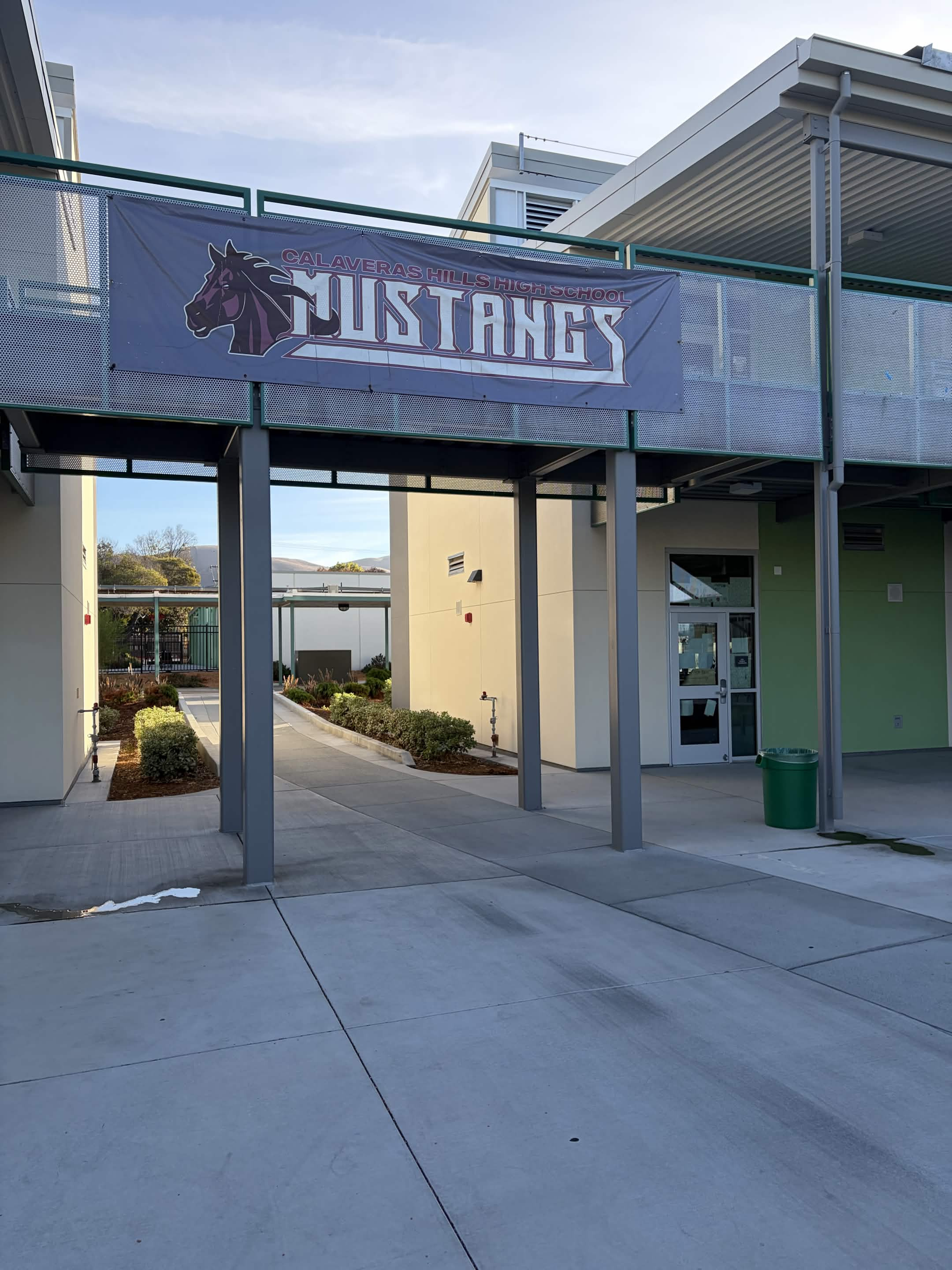
Calaveras Hills High School (CHHS) has served MUSD as a continuation high school since 1969, providing credit recovery opportunities and an alternative schooling environment to help students meet graduation requirements, according to the CHHS website.
The Mustang Academy is CHHS’s alternative education program, where students coming out of middle school are either referred or recruited to attend CHHS for high school, CHHS Principal Jonathan Payne said. The continuation side of the school gives students a chance to recover credits through options such as classwork and adult education after school, he said.
“What we’re trying to accomplish here at Calaveras Hills is to be able to put forth a platform for students that might not necessarily thrive in a traditional setting,” Payne said.
Over the last few years, the graduation rate at CHHS has increased from 71% to 92%, Payne said. Attendance has increased from 75% to 95%, he added.
“Academically, what we’re really trying to do is to get the student to understand that they have people that are here to support them, people that are here to identify even things that they might not know and help them get caught up to speed in that, and let them know that we’re here as the bridge to get them from where they came from to where they need to go,” Payne said.
CHHS graduation requirements are no different from those of MHS, Payne said.
“You need 220 credits with us,” Payne said. “You need 220 credits with Milpitas High. You need 20 community service hours, all those things are the same. English, math, all those requirements are the same. Nothing is different.”
Students at CHHS are receiving quality education just like students at MHS, he said.
“We have the same instructional expectations,” Payne added later. “We have college opportunities, and we also have student support, like I mentioned. It’s really no difference when you look at those particular pieces.”
CHHS students have to take standardized tests and take school surveys just like any other student at MHS, Superintendent Cheryl Jordan said.
“Everybody has to take the 11th grade CAASPP,” Jordan said. “We track attendance, we also track behavior, we also have our climate and culture surveys, and we have teacher-made assessments and outcomes-based assessments.”
CHHS has implemented project-based learning — a teaching method connecting classroom instruction to real-life experiences — and opened up the opportunity for dual enrollment through a partnership with Evergreen Valley College and San Jose City College, Payne said.
Last year, they established a partnership with Cisco Networking Academy, providing students with industry-level standards and certifications, and with Early Morning Late Night, a new digital media program that students are currently using to record, edit, and post a podcast, Payne said.
“It’s not typically at your normal alternative, or even continuation school,” Payne said. “Those opportunities matter because students need to see possibilities beyond graduation.”
The school further supports students through resources such as individual counseling, group counseling, and City Peace Project collaborations, CHHS mental health counselor Katerina Reyes said. They also recently introduced restorative circles, giving each grade level a class period to engage in discussion over community issues and themes in their own lives, and opened a new wellness center in September, Reyes added.
“When I receive a referral, and that’s either going to be for individual or group counseling, the staff has identified that a student is needing some support, whether through social emotional means, academic means, or attendance,” Reyes said. “What we do is we triage what would be best for the student and how we can deliver those services.”
If a student’s threshold surpasses what the mental health department can provide at a school setting, CHHS refers them out to Daybreak and Care Solace, two community-based providers for long term care, Reyes said.
A goal of the mental health department is to lessen barriers that students may encounter when seeking out support, Reyes said.
“Because I’m only one counselor, I really hope that there can be more counselors here on campus to make sure that every single student is being reached in some type of capacity,” Reyes said. “I think we do a really good job of that now, just because we have so many different resources, but I would like for us to have clinically focused counselors.”
When transferring from MHS, students have an option to decide whether or not CHHS would be a better path for them, junior Janell Vasquez said.
“I wasn’t always going go (to CHHS), but it was decided because I was a bit behind on credits,” Vasquez said. “I knew if I stayed (at MHS), I’d just get overwhelmed with work.”
The resources and programs for students who are struggling mentally or academically are sufficient at CHHS, with many after-school programs being offered to promote credit recovery and academic success, Vasquez said.
“After school I do adult-ed, and you just go to the classroom, and you go on subject.com, and you just work on lessons and work to get your credits back from a class that you failed,” Vasquez said.
Apart from being recruited directly into the Mustang Academy, students can enroll at CHHS through a referral, by transferring from another district, or just by coming in after hearing about the school in another way, Payne said.
“We do have an intake (process) when they come to us,” Payne said. “Like when we get a referral, we’ll sit down with them and go over what the transcript is, go over goals, what they’re trying to accomplish, and how we (can help) them reach their goals.”
Conducted by himself or a counselor, the intake interview is an opportunity for students to ask questions and for staff to find out information that will allow them to help students receive the most out of their experience at CHHS, Payne said.
“It’s pretty much like a get-to-know-you,” Payne added.
Vasquez’s experience with taking classes at CHHS has been easier than at MHS due to the more inviting academic environment, she said. However, to her, the coursework is just as rigorous as at MHS, she said.
“It’s easier to ask a teacher for help because there’s less students, and for me at MHS, I was just a little scared too, because there were a lot of students, and the teacher was busy half the time grading,” Vasquez said.
The small class sizes allow teachers to be able to support students more directly, also resulting in less noise and more comfortability in classes, Vasquez said.
The teachers “always check up on us, and whenever we don’t do something, they talk to us, and they always give us options on things to do instead of the stuff we missed,” Vasquez said.
Due to the small size of the campus, Reyes is able to walk around and stop by classes to interact with students, resulting in students feeling at ease and more comfortable to do drop-in sessions with her, she said.
“I think it (having a small campus) benefits the students in the way of knowing where they can go and who they can see,” Reyes said. “I also think it’s beneficial in the way that we communicate as a team, so our teachers are all interconnected. If we have one student one year, we know them next year.”
CHHS is home to students with a wide range of needs, whether that is support with attendance, credit recovery opportunities, or simply a smaller learning environment, Payne said.
“What we typically try to build at Calaveras Hills is a school where students are supported academically, socially, and emotionally, while being exposed to opportunities that prepare them for life beyond high school,” Payne said.