
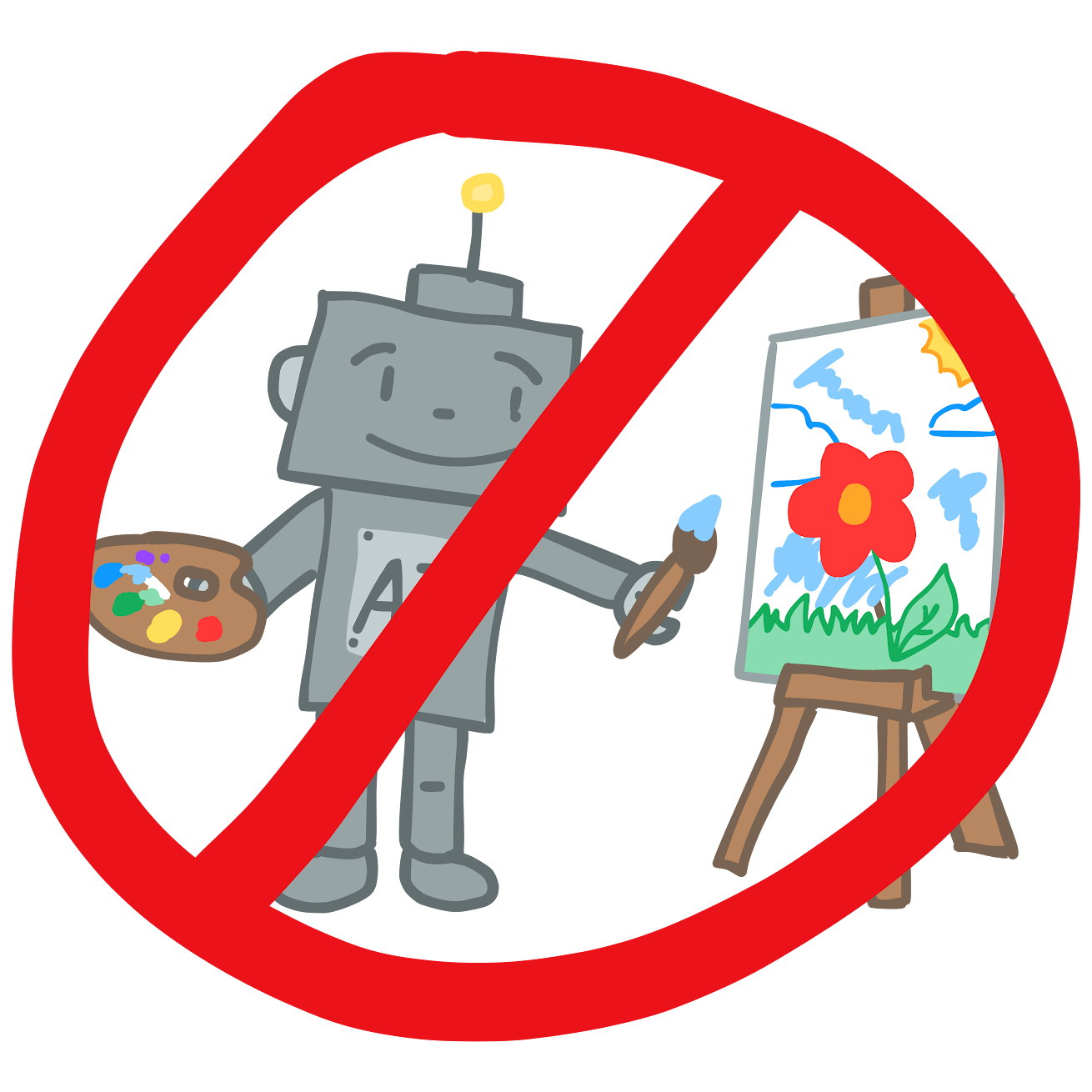
Despite being designed to assist humans and enhance what they already know, artificial intelligence becomes the antithesis of its own intent when incorporated into mankind’s specialty: art.
In 2022, artificially intelligent text-to-image models exploded in popularity. Encouraged by generators like Midjourney and DALL-E 2, people used AI not only in politics and education, but also integrated it publicly into culture and art. The latter of the two categories is where I believe society should draw the line.
According to the Merriam-Webster dictionary, art is defined as “the conscious use of skill and creative imagination.” When an art piece is created, it is intended to evoke emotion and establish a connection between the viewer and the artist. The audience learns to appreciate the effort put into a piece and empathize with its creator, while the artist gets a chance to express their own abilities.
However, unlike humans, computers lack feelings, subjective experiences, and self-awareness. The absence of consciousness causes AI to fall short of the requirements needed to create “art” in the first place, and because AI lacks the intention that humans create with, the connection between artist and audience becomes virtually impossible, contradicting a large purpose of art that is shared.
What may appear to be imagination is instead the result of data patterns and algorithms working together to produce a visual output, as explained in Saint John’s University’s article “How AI Creates Images.” Thus, while viewers can relate to what they see, this system denies them the ability to form a relationship with its creator.
Products like these should not be publicized as physical artworks or even spread online. For the public, the open production of AI “art” conveys a lack of effort, care, and authenticity. From an artistic view, it strips an environment of personality and soul, attacking those who create for themselves by taking up a space that could’ve been utilized by an actual artist.
The use of generated art exceeds the threats that AI poses in educational and professional fields because it concerns not only what a person can do but also who they are as an individual. Creativity is a fundamental part of human nature. If imagination is something that a computer can replicate, I believe we, as a society, have bigger problems on our hands.
For instance, in April of 2024, the Society of Authors conducted a survey about the relationship between new technology and career pathways. Regarding creative occupational categories like illustrators and designers, the data demonstrates a clear decrease in job opportunities as the use of generative AI increases. “A quarter of illustrators (26%) and over a third of translators (36%) have already lost work due to generative AI,” the article said.
This data foreshadows a chain response within human society. As a result of commission artists and graphic designers losing their jobs, individuals may soon lose the ability to make a living through passion altogether. The elimination of this career path leads to less life dedication to one’s craft, fewer expert artists, art with less quality, a lower demand for art because of AI interference, and ultimately the loss of one of mankind’s primary forms of expression.
Additionally, the integration of AI into public art raises serious ethical concerns. Many AI image generators have been accused of training on existing artists’ work without their knowledge or consent. According to the U.S. Copyright Office, artificial intelligence is programmed with access to copyright sources, essentially posing a risk to creator privacy and raising questions about ownership and compensation.
For the first time in history, people are being forced to question the legitimacy of an art piece—who (or what) it came from and the intentions behind its creation—ultimately making it more difficult to appreciate art in its entirety.
When AI art is created and publicized, jobs are lost, connections are shattered, and personal expression is replaced by the precision and effectiveness of a computer, all while bringing down the visual quality of an environment. Until society stops prioritizing generative AI over human creativity, artificial intelligence will continue to be a very damaging “shortcut” for us all.
