
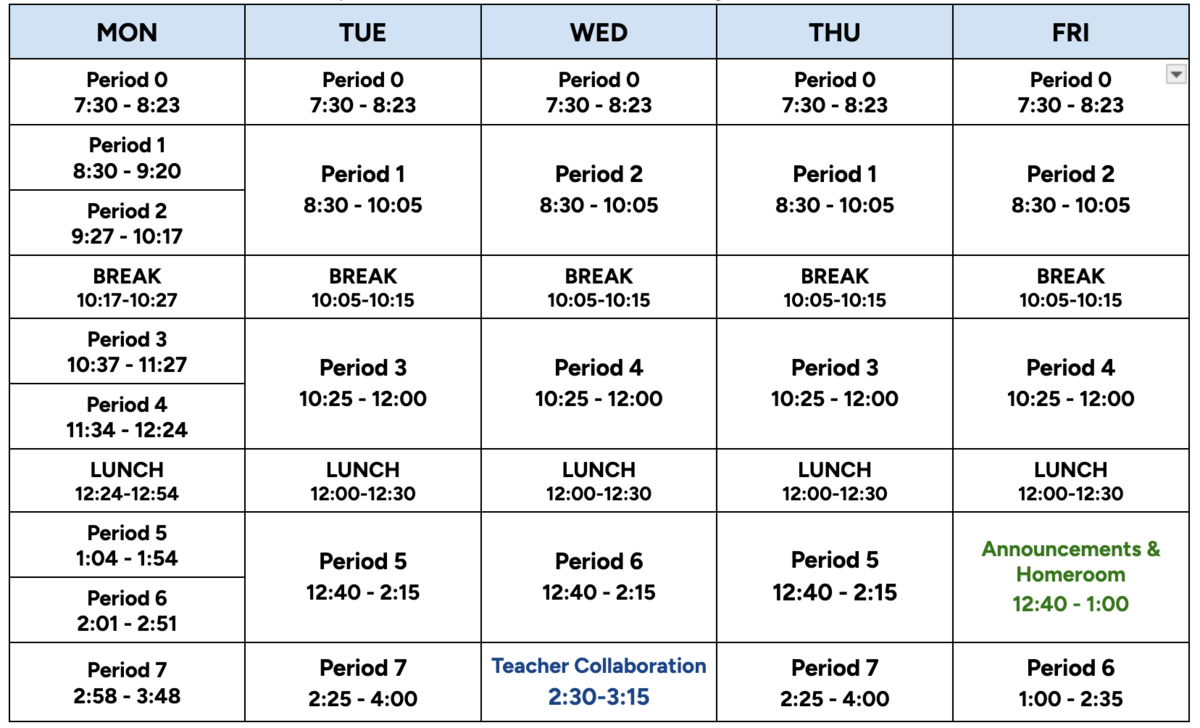
The MHS Main Campus will be on block scheduling for the next school year, according to a post sent out on Oct. 26 via StudentSquare by Principal and Chief Innovator of Milpitas High School and New Campus Programs Greg Wohlman.
The next steps after the passage of the block schedule include planning the training for staff and drafting new policies, among other things, Assistant Principal Dawnel Sonntag said. MHS will be working with the Bureau of Education Research (BER), an organization that will provide specialized educators, in order to organize training for staff, Sonntag said.
“We are planning a professional development on our January professional development day,” Sonntag said. “We have an outside organization that specializes in how to teach on the block schedule, and they will be teaching specific to (subjects). So like a science teacher working with science teachers, math teacher working with math teachers.”
The largest training session will happen in January, but there will be more support offered to teachers throughout the year, Sonntag said.
“There’s one at least one Wednesday a month for the rest of the year that’s going to be dedicated (to training), whether it’ll be the teachers coming together and planning with each other or whether it’s them working with the outside consultants; it’ll be depending on what the department needs,” Sonntag said.
There are also teachers who have taught on the block schedule, Sonntag said.
“Quite a few have taught on the block, so also leveraging the knowledge and the skills of those teachers who have worked on the block to support their peers who may not have,” Sonntag said.
Prior to the block schedule vote, administration wrote proposed language to address the concerns of teachers around who gets to teach periods 1-6 or 2-7 if the block schedule were to pass, Sonntag said. The procedure is not official yet because it has to first go through a Memorandum of Understanding (MOU), when the MTA and Principal Wohlman meet to work out the language, she added.
“We wrote the proposed language, and it basically said that we’ll start with volunteers,” Sonntag said. “If I’m giving the department chairs their numbers, and I would say we need — I’m gonna make this up — two Math I classes seventh period, the math department finds out who’s willing to teach two through seven. If they have volunteers, great. Then we come back and we still need this one section covered. So the department chair and admin go to the department members and say, ‘Who’s willing to do it?’ If somebody says, ‘Fine, I’ll do it,’ they only have to do it for this year, and then next year they’re guaranteed their top preference, and they may love it and want to do 2-7, but whatever they request, they’ll get that request, so that that is the language that has been proposed and that will, I’m assuming, eventually be put into that MOU.”
One of the areas of negotiation that the Milpitas Teachers Association (MTA) was involved in with administration was protecting the teachers’ right to choose whether or not they would teach periods 1-6 or periods 2-7, MTA Vice President Brett Webber said. However, because the master schedule has not been released, there has been no official agreement on the procedure for deciding which teachers teach what schedule, he added.
“It (the master schedule) is massive because we have (so many) different classes,” Webber said. “So six periods a day, five periods a week, five days a week. All of these moving parts, and admin is busy putting that together. The union will not commit to something that we haven’t seen yet.”
Additionally, administration is writing up a policy for which students get priority in having a seventh period, just because there aren’t enough teachers to allow all students to take seven classes, Sonntag said. Students who failed a class, for instance, would be able to take seventh period to recover credit, she added.
“Another example would be a student in AVID who also wants to be in band, or someone in band who also wants to take Spanish their sophomore year,” Sonntag said. “So there’s a number of specific programs or instances where having that ability to get that extra class really helps students.”
Because the block schedule leads to less total instruction time, some of her lectures for her classes may have to be done at home, AP physics teacher Kathleen Downum said. That means that students would have to be accountable and disciplined enough to fully pay attention to the content, she added.
When asked what she expected from the professional development day in January, Downum said, “I think it would be unfair of me because I am fairly pessimistic about what to expect, because there aren’t any magic wands. I think that they’re going to say things that sound good, and when the rubber meets the road, mean doing less.”
Downum is waiting to see what admin will come up with for the training, she said.
“Maybe they do have a magic wand that I’m not aware of, but we’ll see where that goes,” Downum said. “One of the things I hope I get out of it (the training) is how do we hold the students accountable for doing more at home? How do we do that in an effective way?”
Additionally, Downum believes she cannot combine two 56-minute periods worth of content in a single block period because students’ brains are so full of information that they need to go home, process the information, and return back the next day, she said.
“I’ll probably end up adding a summer assignment,” Downum said. “Classes haven’t had summer assignments because AP Physics I is supposed to be your first year taking physics. You can come in and start. So (the summer assignment is) going to be, ‘Here – some video lectures. Hope you get it.’ It’s tough. So we’ll be seeing what the different trainings help us—the teachers—to figure out how to do (teach).”
Until the master schedule comes out, MTA still has questions about block scheduling, Webber said.
“As far as I know, the administration is working diligently, as fast as they can, to create the master schedule because that is cart and horse,” Webber said. “Which one comes first? That’s the first thing that we have to have; we have to have the master schedule. Once we have the master schedule, greater, further, next decisions can be made.”