
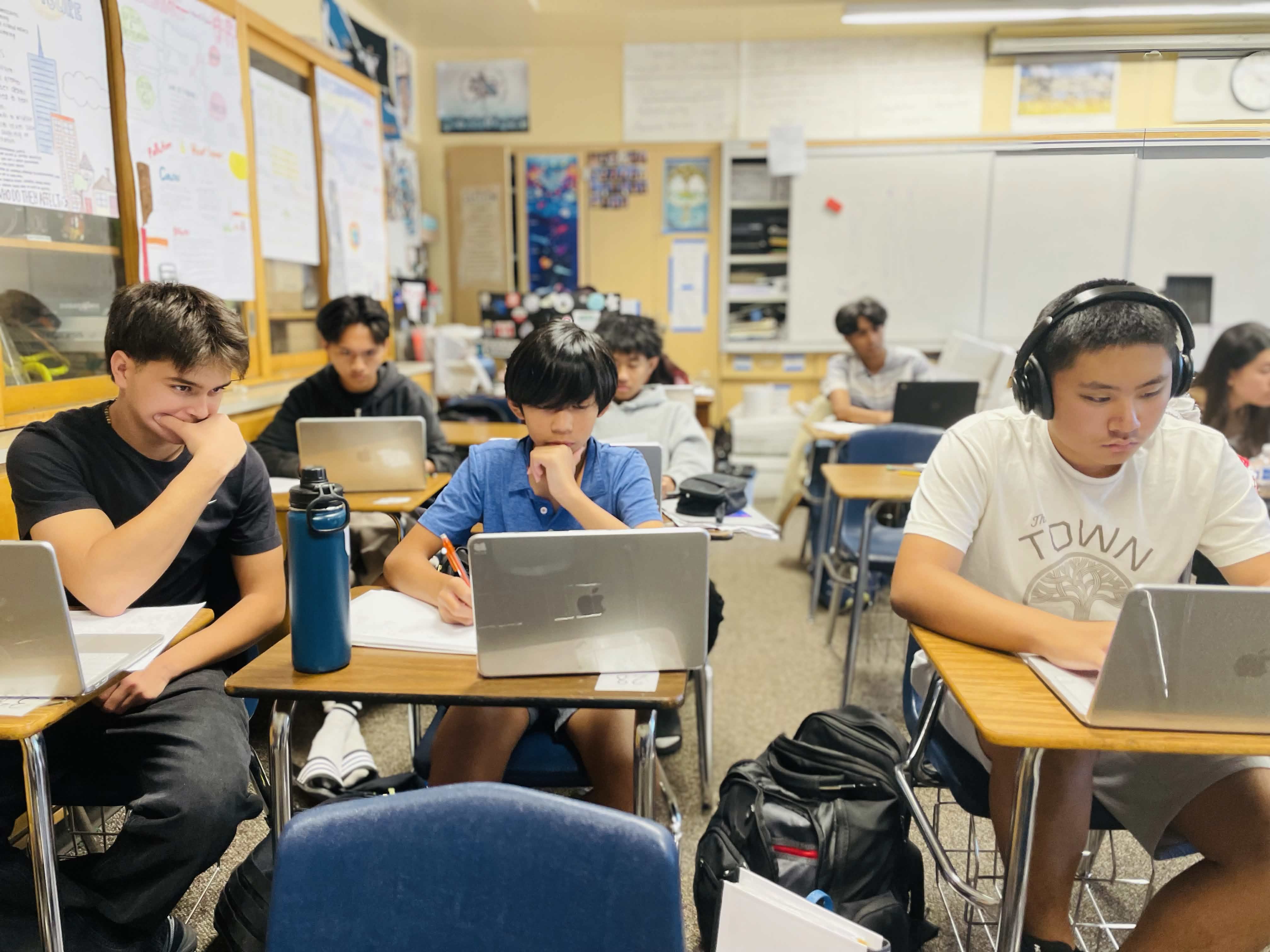
MacBook Neos have been integrated into freshman classrooms starting Oct. 25, Senior Manager of Advanced Technology and Innovative Learning Anh Pham said.
The idea to switch from usage of a Chrome device to a Cloud device was first proposed early this year, Pham said. The factor of a purchase window expedited the order placement and the testing of the model, she added.
“We had to move pretty quickly just because our purchasing window for the devices was tight, and we needed time needed to prepare the devices,” Pham said. “We had to make that decision in the early spring.”
The IT department had to carefully assess whether or not it would be more optimal to purchase MacBook Neos or the Chromebook Plus models, Pham said. The price point difference was a major factor that went into the decision, she added.
“We were able to procure the MacBook Neos in bulk pricing,” Pham said. “It was actually much more affordable than the Chromebook Pluses that we issued last year to ninth graders.”
Time played another major role in the decision to purchase MacBook Neos, Pham said.
“With the Chromebook Pluses, it was quite challenging for us to get enough devices in with enough time to prepare all of them for the new school year,” Pham said. “The MacBook Neos checked the boxes there.”
Apart from logistics, the implementation of the devices in freshman classrooms was justified due to real-world applicability, Pham said.
“We also considered where education and technology is moving, the direction it’s moving in, where students need to be familiar with other operating systems like Windows and Apple Mac, in college, in higher education, and in the real world,” Pham said. “When students begin working, they’re typically not using Chromebooks. So it’s important for them to get familiar with those platforms so that they’re ready.”
MacBook Neos allow students to explore increasingly more diverse platforms and features in comparison to Chromebooks, Pham said.
“It’s just the access to different platforms with Chromebooks. Everything has to be done on the web, and so that just limits the programs that students have access to,” Pham said. “Having the MacBook Neos just opens up opportunities for students and for teachers to use different platforms.”
There are inspections in place before the devices are distributed to the students, Pham said.
“All of our devices are individually prepared, so we’re not pulling them out of the box and just handing them out,” Pham said. “Each one is configured to be set up with everything it needs to have on the back end before we hand it to students.”
However, despite safety protocols being set in place, other projects within the department as well as an flea infestation prevented the MacBook Neos from being handed out earlier, Pham said.
“We had a pest situation in tech services, which we were out of our office for most of the summer and beginning of the school year. So that limited our access to all of the supplies that we needed,” Pham said. “It was fleas. I think it was just a matter of if you don’t have access to your things, and if you’re not in your normal working environment and setup, that just makes it challenging.”
Despite the complications affecting the timeline of the distribution, the situation has been mitigated, Pham said.
“Our maintenance, operations, and transportation team, MOT, handled it and they also worked with outside funders to get it under control,” Pham said. “We’re currently back in our space. We do still have some traps around our office just to monitor and make sure that everything’s okay. And so far, it’s been great.”
As the IT department continues to support the technological growth at MHS, they will leave the long-term plan for the MacBook Neos after the freshmen graduate as undecided for now, Pham said.
“Typically, we would have those four-year-old Neos recycled back down into our younger grades to use, but there could be the possibility to purchase,” Pham said. “That’s just something that’ll be determined as we get closer to 2030.”
The MacBook Neos are vastly more durable for learning, freshman Anwesha Bankwar said.
“The Chromebooks were really slow, their battery life is really bad, and it just used to die at the end of third period,” Bankwar said. “The MacBook Neos can sustain throughout the whole day.”
The potential for efficiency is also maximized with the introduction of these new devices, Bankwar said. Its features are also advantageous to ensuring tighter security measures are in place, she added.
“You can use touch ID if you enable it in settings, and you can use it to put all your passwords in, which is easier than typing in your password every single time,” Bankwar said.
Overall, the customization that the Apple environment allows is an added bonus, Bankwar said.
“It lets you have multiple widgets on top of the screen,” Bankwar said. “You can see the time instead of looking all the way down, and your notifications just pop up instead of you having to click on them. These intuitive shortcuts are why I think that MacBooks Neos are better than Chromebooks overall.”
While students seem to be generally satisfied with the addition of MacBook Neos to the learning environment, teachers are still navigating the difficulty of monitoring student activity on these devices, English teacher Cindy Ung-Sato said.
“In terms of Securly, it’s been a problem,” Sato said. “I mean, now more than ever, students are able to play games without me being able to block it because they’re in-app games that have already been downloaded into the MacBook Neos. It’s really frustrating that IT or whoever didn’t screen these MacBooks to remove these games because Securely can only block anything through the Internet as a site, but they can’t block apps that have already been embedded into the MacBooks.”
However, the main struggle is in ensuring students are honoring academic integrity online, Ung-Sato said.
“I use Google Forms for quizzes, so students don’t have to wait days for me to grade it by hand,” Ung-Sato said. “But Google Forms on locked mode doesn’t work for MacBook Neos; it only works for Chromebooks. Now I’m unable to administer quizzes with peace of mind.”
She does not know if the IT department is finding a solution to this issue, so a temporary solution for testing will be enforced, Sato said.
“I have to probably move my quizzes to paper, probably for spring semester,” Ung-Sato said.
Even though the students get an opportunity to utilize modern technology, the purchase is not fully justified unless the IT department is able to find a solution for testing security, Ung-Sato said.
“They didn’t anticipate these problems that teachers would experience,” Sato said. “If only they actually asked some teachers to do some beta testing on this, that would have been helpful before they were released. It seems to be a pattern that it’s always placed on the teachers to navigate a solution to the issues associated with shifting technology.”
