
Rating: 3.5/5
What is the connection between storming the Capitol and scrolling Instagram reels? Facebook. Or rather, as rebranded, Meta.
The Facebook Files were published in the Wall Street Journal in 2021, detailing the shady hand Facebook has in downplaying its various harmful effects on users.
“The Social Reckoning” hit theaters on Oct. 9th. Directed by Aaron Sorkin, who previously directed the predecessor film “The Social Network”, the movie tackles a dramatization of how the Facebook Files were compiled through the storylines of Facebook whistleblower Frances Haugen, journalist Jeff Horwitz, and Mark Zuckerberg.
The algorithm pushes followers to extremist content, increases self-image issues young girls experience on Instagram, and allows criminal groups to organize activities on the site. Most importantly, Meta has not taken action against many of them.
Like many journalist procedural dramas, “The Social Reckoning” converts long tedious journalistic processes into a digestible story. The movie’s nonlinear narrative structure jumps from Haugen and Horwitz’s collaborative investigation in 2019 to the 2021 Facebook PR team crisis, with one asking questions and the next scene answering them. The overall plot was engaging because of the dual perspectives of the investigators versus the investigated and because of the harmonious welding of the two timelines in the third act.
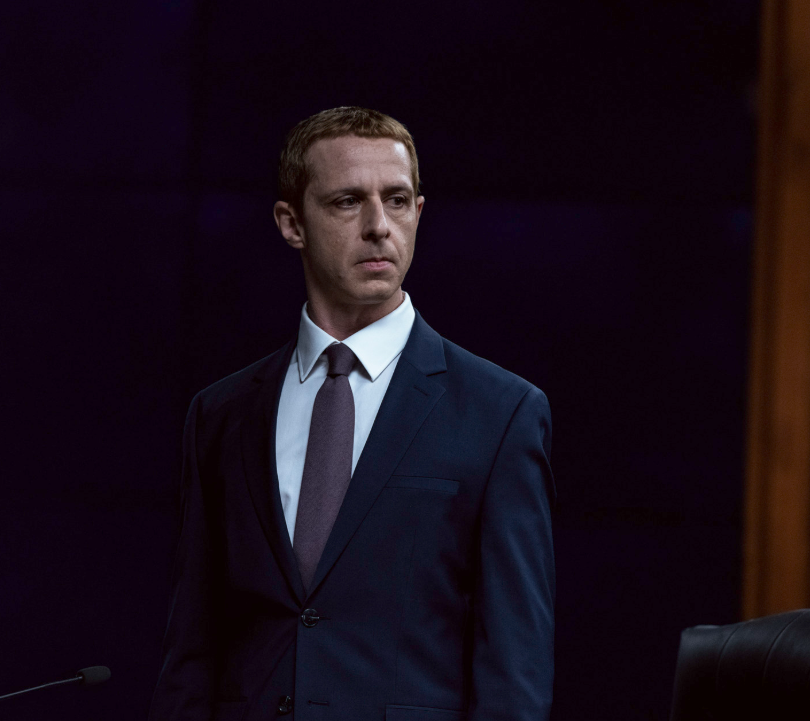
The characters are distinct from their real life counterparts, but Haugen and Horwitz’s fictitious personas have compelling personalities and dynamics. Jeremy Strong delivers a strong performance as Mark Zuckerberg, who is a stiff, neurotic, and robotic boogeyman of capitalism who practices his court trials with a mock stage and a PR team instructing him on a natural head tilt friendly to humans. I was mildly vexed by the attitudes of minor characters, such as Horwitz’s aggressively exacting editors in the Wall Street Journal (WSJ), although that may be a normal aspect of newsrooms that I am unaware of due to having only been in one.
Some parts felt forced for the sake of the narrative, such as Haugen’s recurring conflict with a coworker for the sake of suspense. When a journalistic procedural movie adds in fictitious elements, the plot requires a balance between the drama and the facts. However, the movie hits all the major facts in the investigation and it does not drag on to become boring.
At the climax of the film, segments of bloody Jan. 6 capitol rioting are cross-cut with Haugen’s testimony in Congress. Besides this scene, the emotional payoff of the film is not too intense, and unless you have experiences with extremist Facebook groups, it wouldn’t leave much of an imprint. Nothing warranted much more than a “wow” or a sigh, much like a documentary instead of a drama in that regard.
Perhaps the film could have explored additional harmful side effects of Facebook beyond Horwitz’s reports to his editors and Zuckerberg’s mock trials. I think the film’s opening scene showed the right-wing extremist perspective well, but the movie did not show the Facebook user to Capitol rioter pipeline well.
But at the same time, the film maintains relevancy. “The Social Reckoning” reminds us of the polarizing risks social media has on our psyches and the natures of the companies behind the screen. The algorithm feeds into emotional reactions, pushing ‘ragebait’ as a consequence. In this day and age, social media is a platform for every kind of social interaction. As Zuckerberg announced, these “meaningful social interactions” can connect us, but they can also show an unrealistic view of real life, a fact that gets taken advantage of. A movie like this is a good reminder of how easily people are susceptible to the technologies in our hands.
