
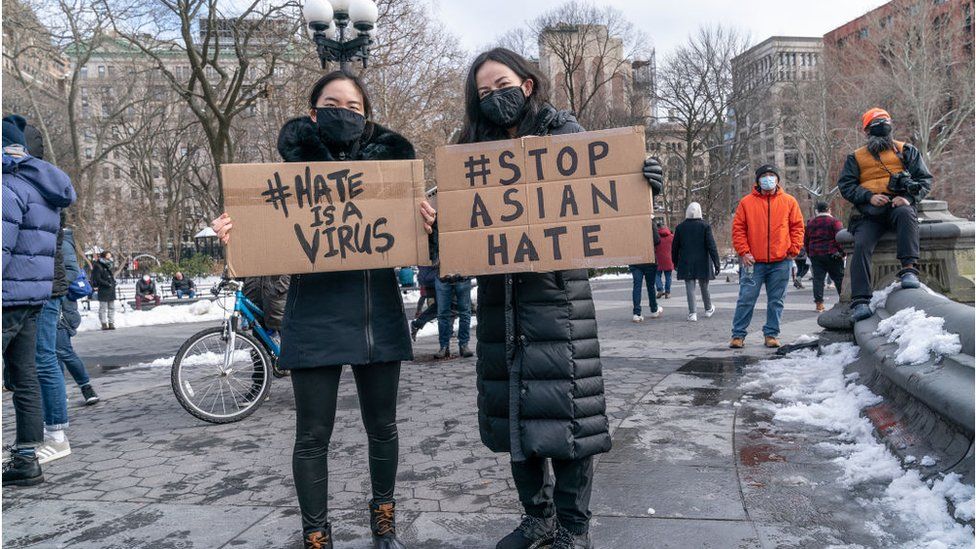
 On March 16, a man walked into three spas in the Atlanta area and shot eight people to death, six of whom were Asian women. One of the spas targeted was Young’s Asian Massage. When questioned about his motives, the perpetrator claimed that he suffered from a “sex addiction” and wanted to remove the temptation, a claim that suggests the women shot were sex workers. Since there is no definitive proof that the shooting was racially motivated, the perpetrator has not been convicted of a hate crime.
The Atlanta shooting is one of the most recent and violent attacks in a long, distressing series of hate incidents against the Asian American community. The incidents have surged during the pandemic—people have been blaming Asian Americans for the spread of COVID-19, especially after former President Trump called it the “Chinese virus” and “Kung Flu.” Asian Americans have been shoved to the ground, insulted for their race, and coughed and spat on. These targeted incidents, although abhorrent, are much less severe than other hate crimes. Asian Americans have been set on fire, stabbed, and murdered. The Atlanta shooting incited a wave of coverage and support for the Asian American community, thrusting the discrimination they face into public discourse and sparking discussion on the efforts needed to combat it.
As an Asian-American female with a Vietnamese name, I was unsettled thinking about how the amplified hatred towards Asian Americans might continue even after the pandemic, especially since many victims are women. I could be targeted for both my gender and ethnicity. More than that, though, I was surprised by my own lack of knowledge about the discrimination that Asian Americans have faced. I was unaware of how Asian women have been sexualized starting with the Page Act of 1875, which assumed Chinese women were prostitutes and prohibited them from entering the United States—a stereotype that might have contributed to the Atlanta shooter’s supposed motive and the allegations on the sexual nature of Young’s Asian Massage. Additionally, although I was aware of the model minority myth’s effects, I did not know about the term “model minority myth” or the history behind Asian American discrimination until my English teacher discussed it.
The model minority myth perpetuates the stereotype that all Asian Americans are hardworking and successful. However, according to Pew Research Center analysis of data from the U.S. Census Bureau, Asian Americans have the largest income gap among all ethnicities. Those in the top 10th percentile earned 10.7 times more than those in the bottom 10th percentile. The model minority myth excludes Asian Americans from the lower end of the socioeconomic spectrum. Since it implies that Asian Americans do not suffer from hardships, it erases much of the other forms of discrimination against Asian Americans, like the Chinese Exclusion Act and the Page Act of 1875. Additionally, it pushes the stereotype that Asian Americans, particularly women, are quiet and submissive. It might have also contributed to the undercoverage of hate crimes prior to the Atlanta shooting.
To combat the model minority myth, I would first advocate for more school education on discrimination against Asian Americans and representation of Asian American narratives in the curriculum. I commend inidividuals’ efforts to educate others, too, including social media advocacy, articles and literature on discrimination, and educational discussions with those who believe harmful stereotypes about Asian Americans.
Similarly, I support increased community efforts. Volunteers have formed community patrols to share resources, escort Asian Americans through the streets, defend victims of bias incidents, and report hate crimes. They also translate for Asian Americans who face language barriers. Anti-racism education and community efforts will help eliminate the root of the problem: the misconceptions ingrained into the minds of people who commit acts of hate, along with public ignorance and inaction towards discrimination.
In terms of legal efforts, I also support more reporting and stricter enforcement of hate crime laws. An alternative to reporting to the police is reporting to community groups, like Stop AAPI Hate. Increased reporting and documentation would show the full severity of both bias incidents and hate crimes, counteracting the model minority myth and validating the experiences of Asian Americans. Additionally, investigating hate crimes (like the Atlanta shooting) more thoroughly and classifying them as hate crimes would lead to greater recognition of discrimination and reassurance that victims will be taken seriously. President Biden recently endorsed Grace Meng’s COVID-19 Hate Crimes Act, which would expedite federal review of hate crimes during the pandemic and increase the reporting of hate crimes among state and local governments. I think the bill is a step in the right direction, but I hope that the outpouring of coverage and support will not die down after the pandemic.
On the other hand, I do not necessarily support more policing. Undocumented Asian Americans might be afraid that they would have their immigration status questioned if they turned to the police. They may also be concerned that marginalized communities would suffer from increased police brutality. Additionally, it is difficult to categorize crimes as hate crimes due to how there is no universal symbol for hatred towards Asian Americans, and since they are often handled by local rather than federal law enforcement, they tend to go unpunished or be inconsistently enforced. There is not much evidence that more policing decreases hate crimes, either. While policing may be the most feasible immediate course of action, I see it as less viable than community efforts in the long run. It might be ineffective, harm other minority populations, widen the wedge between Black people and Asian Americans, and discourage victims from reporting hate crimes. Ideally, rather than being the sole or primary solution, the police should work with community organizers. For instance, community patrols can cover areas where there might be a less prominent police force.
The recent rise in hate incidents against Asian Americans reveals the need for greater action against discrimination and racism. There should be more emphasis on education, community efforts, reporting, and stricter enforcement of hate crime laws. Now that the deeply rooted hatred against Asian Americans has been recognized, the next step is to combat it with proactive behavior and solidarity.
*If you want to support the Asian American community, you can do the following:
- Donate to groups like StopAAPIHate and The National Asian American Pacific Islander Mental Health Association
- Report hate incidents and speak up for the victim(s)
- Contact politicians about bills affecting Asian Americans
- Participate in ASB’s AAPI support video for the Asian American community at MHS
- Share resources, educate others on the discrimination

