
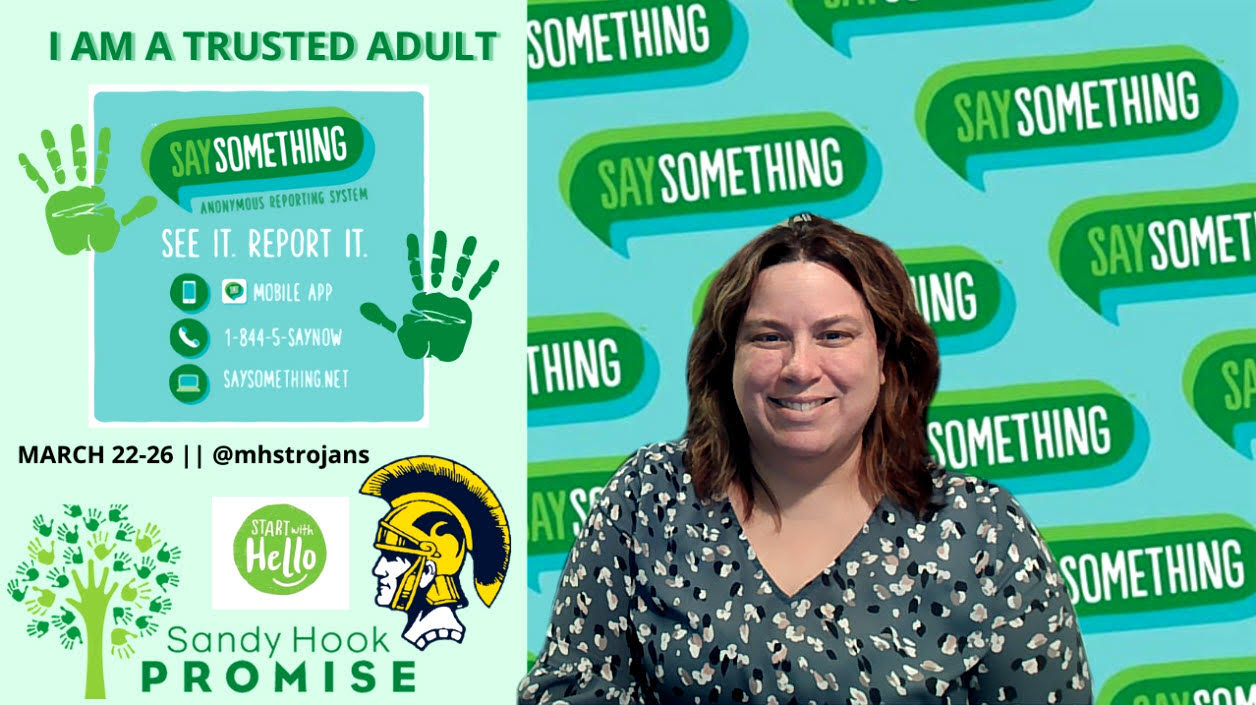
You may know Letta Meyer as the AP Chemistry and Forensics teacher, and as the advisor of Science Olympiad. However, outside of school, she is a student herself at the University of San Francisco, where she is pursuing a doctorate degree.
After Meyer graduated from high school, she had planned to major in accounting, Meyer said in a Zoom interview. However, after taking Physical Science 101 in her first semester of college, she realized that she loved the chemistry aspect of the class, she said. She then decided to take freshman college chemistry, which led her to switch her major to chemistry, she added.
“I think the biggest thing that I feel with science [is] that there’s a lot of explanations of why things work the way they do,” Meyer said. “I like to figure out why things do the things they do, not just that they do it.”
Meyer said she knew very early on in pursuing her bachelor’s degree that she did not want to work in a lab. However, she realized that she was very good at explaining chemistry, so she decided to explore the idea of teaching by shadowing a chemistry teacher at a high school, she said. In that class, there was a student who had been very sick and had missed about two months worth of material, so Meyer decided that it would be her duty to bring the student up to speed, she said. It took about a month for her to catch the student up, and in that time she grew to love the idea of pursuing teaching as a career, she added.
“As far as teaching goes, I was exploring some different things,” Meyer said. “I knew that I wanted a master’s degree, and so I ended up getting a master’s degree in educational leadership [where I learned] about the different parts of [administrative] work. But then later I thought about doing different things, and all of them had to do with having a doctorate of some kind. And so about five years ago, my life just got to the point where I could do it. I started exploring programs and so that’s how I ended up at USF, [where] I am learning an instruction doctoral program.”
Meyer is currently in her fourth year and has started working on her dissertation, she said. The topic of her dissertation is women in STEM, and it focuses on diversity in STEM subjects such as engineering, physics, and computer science, Meyer added.
For her dissertation, Meyer plans on looking at data of MHS students to see what colleges students go to, what majors they pursue, what AP classes they take, and so forth, Meyer said. Compared to other places, MHS does not have as much of a gender discrepancy in STEM, she said. She is trying to figure out what we are doing differently at MHS so that we are not following the same trend as every other place, she added.
“So some of the research that I have been reading and working with really has to do more with what we call science identity,” Meyer said. “[Some of science identity] is having role models but also keeping your interest in science up. Some of the clubs and organizations that we have on campus are fantastic [such as] our Robotics Club, our STEMgirls, and our Science Olympiad.”
Unfortunately, in today’s society there are still men who look down on women in STEM, Meyer said. Some men will commit microaggressions or over-explain things to show that a woman does not belong in STEM, Meyer added.
“It was actually really kind of a miracle that I made it into college with a STEM focus at all because my high school physics teacher was the worst,” Meyer said. “My class had literally two girls in it. [We] were able to do things and understand things pretty well, but [our teacher] would just ignore us in class. [We] tried to ask a question, and he would just ignore us, or wouldn’t answer us, or would do what sometimes is called mansplaining. It got so bad that the boys that sat around us in our class, figured out what was happening and so we would give them our questions and have them ask them so that we could get the answers that we were looking for. It was awful. I think that’s one of the reasons why I still struggle with physics is because of that [experience].”
While Meyer had some unpleasant experiences as a woman in STEM, she was able to persevere because of a chemistry class she took in college, she said. Her chemistry teacher was a woman, and helped Meyer realize that she belonged in STEM and that she had the skills to work as a chemist in a lab if she wanted to, she said.
“I think one of the biggest things is continuing to open up opportunities and giving more people access,” Meyer said. “Not just those that can afford the access, or those that are really struggling to make ends meet and therefore would qualify for extra help, but this group in the middle also needs it. That’s really where I think we also have to look at.”
Her advice for women and minorities in STEM is, “Don’t let what other people say or do, whether intentionally or inadvertently, to you make you question what you know or that you belong, because you do belong in STEM,” Meyer said, “There is nothing that says that you have to be this type of exact person to belong in STEM. You don’t have to be Albert Einstein to do science stuff in any way. But being able to remember that you have a different perspective and that different perspective is what is needed.”

