
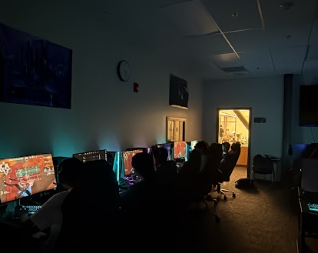
Recently, the MHS esports program transitioned from being a club into an athletic program. About halfway through this school year, the club realized they could become an athletic program, esports advisor Steven Martinez said.
After speaking to Athletics Director Clarence Wrencher, the club learned that if they were going to be an athletic program, they’d have to go through a lengthy process, Martinez said.
“You have to get coach-certified and CPR-certified as a coach,” Martinez said. “Players need athletic clearances, so they need to get physicals according to the California Interscholastic Federation’s (CIF) rules.”
Having a dedicated esports program allows it to be under the umbrella of the athletics department, which makes it a lot easier to put together events and fundraise compared to being a club, Martinez said.
“My vision is that eventually we can be a huge program for the district that can match those programs (other sports) in terms of incoming students — students that are excited to come to Milpitas High School to be a part of the esports program,” Martinez said.
For now, the program only has a few pilot teams in order to figure things out, like navigating esports leagues like CIF and PlayVS, and figuring out communication between coaches, Martinez said.
“We’ll hold tryouts,” Martinez said. “Just like any other sport, you hold tryouts. Students come, they play, see what they’re all about, and then we make teams from there, and those teams are going to play in the PlayVS league.”
Once those pilot teams are settled and playing matches, in the spring they’re going to focus on things like social media, broadcasting, and having a graphics team, Martinez said.
“We want to grow into this legitimate program, and in order to do that, you need those separate teams of students and student leadership within the program to help guide those individual parts of it,” Martinez said.
Currently, the program offers only a few pilot games, Martinez said.
“There is a varsity Super Smash Bros Ultimate team — as well as a junior varsity team — there’s a Rocket League team, and also a player doing Street Fighter in a league for high schoolers hosted by the Electronic Gaming Federation,” Martinez said.
The MHS Valorant team competed in a tournament hosted by the University of Silicon Valley (USV) in January and won, receiving custom jerseys for the team as well as a large trophy, which is on display outside of the esports room, junior Finn Chadda said.
“We’re competing in Valorant for two tournaments in April,” Chadda said. “We’re competing to keep our cup (from USV) then because more schools want to challenge us for that cup.”
Martinez put together a tournament for Super Smash Bros Ultimate on the last Friday of February, which received representation from both the Innovation Campus and the main campus, he said. There will be more tournaments at the end of every month for the rest of the school year, with plans on adding a Valorant tournament as well, he added.
“Once our program becomes big enough, we could offer interdistrict events, inviting Independence High School or high schools from Fremont, anywhere neighboring that would like to attend,” Martinez said.
The district has been generous in getting the program off the ground, Martinez said. The program has 24 personal computers (PC), four Nintendo Switch 2s, four PlayStation 5s (PS5), and many Nintendo Switch Pro controllers and PS5 dualshock controllers for the consoles, he added.
“The funding is pretty generous at the moment,” Martinez said. “However, in fall 2026, we’re going to essentially be on our own as a program, and that’s where the fundraising is going to have to come in. That’s where there’s going to be an expectation of, ‘If you’re on the team, you’re going to have to help fundraise.’”
There were no consoles in the esports room at the start of the school year, Martinez said. He had to bring his own Nintendo Switch and Nintendo Switch 2 from home so students could play Super Smash Bros, he added.
“It was really janky, we had crappy monitors, and I had to buy external speakers, just not very put together,” Martinez said. “Then I proposed to Wohlman that we should get some consoles. So we got Switch 2s, we got PS5s, and that also helped because we are piloting a few teams that are playing for CIF currently.”
The teams aren’t exactly ready for CIF, but participating in CIF gives the kids tournament experience, Martinez said.
“It gives them a sense of community, and it gives them something to play for, instead of just playing casually or for fun — which is fun — it’s just if you’re trying to build an esports program, you also need that component of competitiveness,” Martinez said.
Student transportation to the Innovation Campus is currently in development, Martinez said. If there are students at the Innovation Campus who want to compete and play sports for MHS, there’s a bus that takes them from Innovation to the main campus, and the expectation will be the same for esports, Martinez added.
“The reality is that the esports facility is at the Innovation Campus,” Martinez said. “We have the 24 PCs. We have the console room currently. If we hold tryouts and students make the team and they’re at the main campus, they will be provided that transportation in order to get here so they can compete for the school.”
Joshua Sheridan, the main campus’s esports club advisor (a separate club), has three gaming PCs and four PS5s in his room on the main campus with some Nintendo Switch 2s on the way, Martinez said. The plan is for it to exist as a satellite room if something comes up where it makes more sense for a kid to stay at the main campus, he added.
“That’s another benefit that esports has that other sports don’t,” Martinez said. “When you’re on a traditional sports team, everybody needs to be in the same place. But in an esports space, you can afford to maybe have a day of practice where a couple of main campus students stay on main campus, and they’re playing there, and they’re communicating with their team through Discord.”
Chadda is excited for more people to actually see esports as a growing sport option, he said.
“I know a lot of parents like to think of it as, ‘Oh, is it for fun? Do kids do this just willy nilly?’ — but, realistically, it’s not all like that, and it allows students to actually express something that they spend a lot of time in,” Chadda said.
Sophomore Ajay Xiong, who plays for the Valorant team, thinks it’s really fun playing in the esports program, and he spends most of his time in the esports room, he said. If you go home and play games anyway, it makes sense to join the esports team, he added.
“It’s a pretty positive space,” Xiong said. “You meet a lot of new people in esports, and it’s really fun. I would say, if you have the time, because some people don’t have the time, especially from the Main (campus), to drive all the way over here and have their parents drive them all the way back. I get that. But if you have the time, then why not?”
Martinez is still trying to establish the program, so it’s starting small for now, he said. In the fall, a hard launch of the program with more structure is planned, including branding, jerseys, and tryouts, he added.
“In the fall, we are absolutely going to offer Smash, Rocket League, and Valorant,” Martinez said. “Depending on student interest at that point, we could add Marvel Rivals or League of Legends, but it entirely depends on what students want, and if there’s students that want to step up to help lead those teams.”