Running marathons is not easy, especially long distance ones. They require weeks and months of training and need a lot of discipline.
Social Studies teacher Lauren Byler-Garcia has run two full marathons and several half marathons, she said.
“I also did a few triathlons (an endurance multisport event that consists of swimming, cycling, and running, completed sequentially in that exact order) so I did one 70.3, which is a half Ironman (a type of triathlon), not a full Ironman,” Byler said. “So that is the extent of most of my running and triathlon background.”
Her first marathon was the San Diego Rock and Roll, she said.
“I kind of started training and then I’d have aches and pains, and I didn’t really have any knowledge of what shoes you’re supposed to have,” Byler said.
Byler started running after her senior year of high school, and it was a way to stay fit, she said. Byler had body dysmorphia, so she thought running was a way to lose some weight, she added.
“I never paid attention to pace or anything like that at first, and then there were a few times I didn’t have access to exercise equipment, so running was easy and free,” Byler said. “I had joined a running group, so it started with a running club, and all these people who ran marathons and half marathons, and then my girlfriend, who used to be a teacher next door. She was going to do a half marathon with one of her friends, and then I said I’ll do it.”
While running a marathon, you’re using the same muscles over and over again, so mile nineteen and twenty are when your body kind of gives up, Byler said.
“It doesn’t matter how much training you put in; it just does not want to operate,” Byler said. “So you have to have the mental capacity to push yourself through. It’s really a mental game. The first twenty miles are physical, but it becomes a mental game once you get past that.”
Byler feels like some people, not of this generation, will tell one not to push themselves into feeling comfortable, she said. Byler thinks that part of dealing with life is to push oneself to one’s limits, she added.
“I think that part of feeling with life, you have to push, push boundaries and be willing to try things, even if it exhausts you,” Byler said.
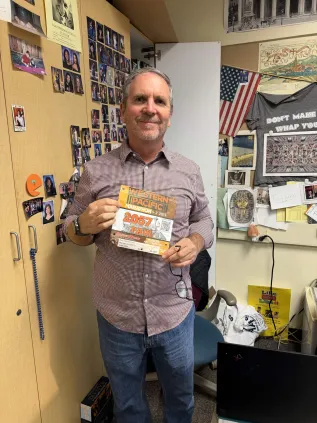
Social science teacher Paul Harrison has run one marathon, the Eastern Pacific marathon, he said.
“I trained with Mr. Cummins,” Harrison said. “He’s done many, and so I started running, especially with him, because I saw it’s a great way to get in shape and then also it’s a great challenge.”
Training before a marathon is important, and Harrison did the Hanson method which is a 18 week training program, he said.
“It’s really helpful to have a training partner or team to work with,” Harrison said.“I’m a total believer that you need to follow a training program, and if you want to do one (marathon) with a decent time, it really helps,” Harrison said.
When training, you slowly build up your distance and then work on speed, Harrison said.
“It’s always hardest at the beginning, like even if you’re in great shape,” Harrison said. “When you start running, it’s harder, and then your body gets in sync, and then it gets a lot easier, so starting the process is the hardest part,” he said. “The hardest part (in a marathon) is that last mile – it is at least for me; it was really challenging.”[;’p-
Harrison sees a connection between his training for marathons and his AP world history class, he said. The process of planning really helps, he said.
“I got to set up my training program and follow this system, and if students follow the system, I think usually they have great success,” Harrison said.
Social Studies teachers run marathons outside of running their class