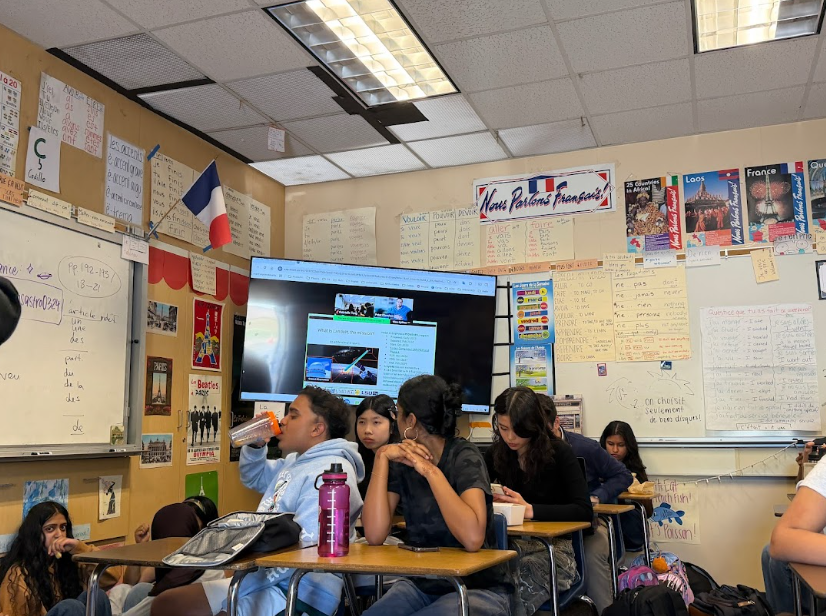
Dr. Peter Plavchan from George Mason University was invited by the MHS Astronomy Club to give a presentation about his career path and the NASA Landolt mission on March 24 in room H03. Roughly 25-30 people were in attendance for the event.
The presentation started with Plavchan discussing the history of the James Lick Observatory and how it was visible from Milpitas. He then delved into his career and various accomplishments.
“I’ve contributed to the discovery of over 6,000 planets that are known today to orbit stars other than our sun,” Plavchan said in his presentation. “I helped discover a baby planetary system. The second closest baby star to our sun has a system of at least three transit planets and a debris disk that’s been known since the 1980s.”
Near the end of his presentation, Plavchan talked about the NASA Landolt space mission, which he is the principal investigator and lead for.
“This mission is to build a satellite and fly it into space and look at it with ground-based telescopes, so that it appears like a star to us,” Plavchan said. “And since we can control the light that is coming out of the satellite, we can use it to calibrate the stars around it in our field of view.”
Senior and Astronomy Club President Gabrielle Tong met Plavchan through a research program she did at George Mason University over the summer, she said. She emailed him to see if he would be interested in sharing his expertise, she added.
“I was hoping that our members would get a better sense of what a career as a professor and researcher in astronomy is like, as well as the experiences that he has with the Landolt mission that he’s working on,” Tong said.
The event went very well and had a high attendance turnout, Tong said. One of the Astronomy Club’s goals is to expose people to possible careers in astronomy and interesting aspects about the field of study, she added.
“This subject (astronomy) is rarely covered in the school curriculum,” Tong said. “So we believe that these guest speakers are a great way for our members to gain some exposure.”
This event was a good way for people interested in STEM to find out more about astronomy, Senior and Astronomy Club Vice President Maitri Singhal said. Singhal believes the event went well and that people were interested in Plavchan’s conversations, she said.
“I think we had a lot better turnout,” Singhal said. “Initially, we didn’t have that many members, and now we have consistent members. So I think we’re able to outreach to more people.”
Freshman and Astronomy Club member Hariharan Srikanth found Plavchan’s presentation intriguing and liked how he learned more about NASA, he said. There should be more guest speaker experiences like this, he added.
“Probably another scientist generally, or somebody involved in active research,” Srikanth said.
The club has plans to invite more guest speakers in the future, Tong said.
“We’re just glad that we have guest speakers to share more about astronomy with our student body,” Tong said.