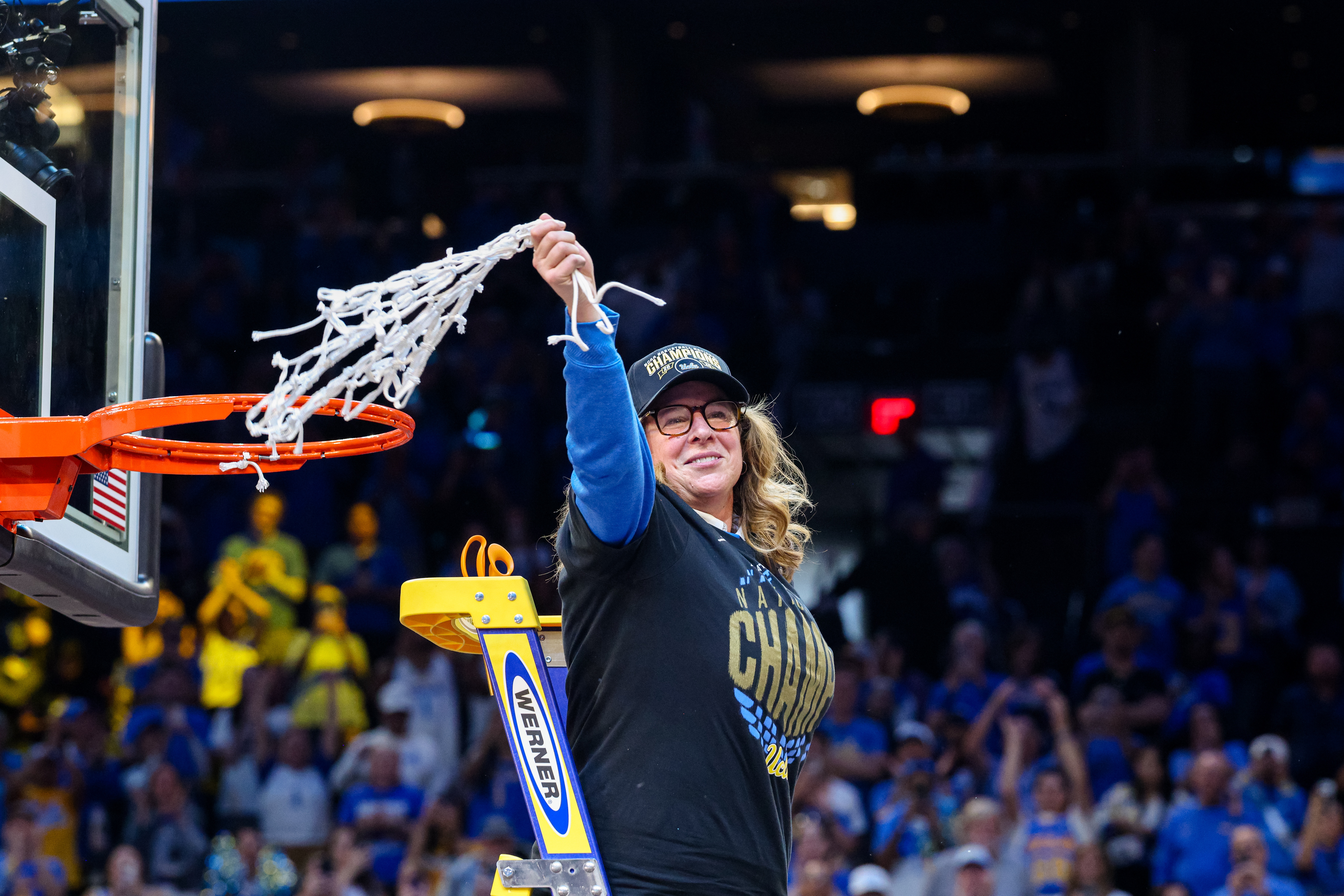
A little more than 35 years after late nights as student body president, getting suspended for organizing senior cut day, and receiving the Leo B. Murphy Award in 1989, MHS alumna and UCLA women’s basketball head coach Cori Close cut down the net at the NCAA Division I championship.
To win the championship “in such a dominant fashion” and to have played so well was incredibly special and gratifying, and it felt like it all came together at the right time, Close said.
“You always dream, as a coach or as a player, of when the confetti falls and of what it’s going to be like, cutting down the nets and having all the families down there,” Close said. “My mom was right by my side, and being able to honor her and thank her was really spectacular. Bob Kellogg, who was a football coach (at MHS), was there with his wife … It’s sort of indescribable, but it was an amazing feeling.”
Marking the first NCAA championship win for the UCLA women’s basketball team in school history, UCLA also set a record for the number of players drafted into the WNBA. All six of the seniors on the team were drafted, Close said, with five of them picked in the first round and one being the third pick of the second round.
“When I was watching the draft in New York, I was like a proud parent,” Close said. “I couldn’t be more proud. What I love is that it’s a great reminder that when you sacrifice for the whole team, in the end, it comes back to you individually.”
This moment was the latest chapter in her basketball journey, which began in Milpitas, where Close grew up. She was exposed to sports at a young age, and although she was better at soccer for a long time, she always had a love for basketball, she said.
“Earliest memories: my dad was a coach at Milpitas High, and I was three years old,” Close said. “There is this picture where I’m holding a ball that is almost bigger than I am. I was dressed in this terrible bowl haircut.”
After attending Alexander Rose and John Sinnott Elementary School and Rancho Milpitas Middle School, Close was a student at Milpitas High, where she mostly played basketball and badminton, and also ran cross country once, she said. Her dad was a psychology and health teacher at MHS for 35 years, so even before she was in high school, she was there “all the time,” she added.
“It was such a proud town — still is, I’m sure,” Close said. “I just have nothing but amazing memories. Being involved in student government, I remember that. I remember the people in my class, I could name them by name.”
She recalls an activity in her dad’s psychology class in which students planned a fake marriage to learn about budgeting, communication, and relationships, as well as “Faculty Follies,” a fundraiser skit night featuring teachers.
“I always say that it takes a village to build a basketball program,” Close said. “It also takes a village to raise a child, and so many people of the Milpitas High School community helped raise me, and I’ll be forever grateful.”
As a high schooler, Close didn’t realize she would go on to coach for the rest of her life, but after college, she fell into it and has been doing it for 33 years now, she said.
“I couldn’t afford, probably, to go to college if I didn’t get a scholarship, so I knew that I wanted to pursue basketball in college,” Close said. “I thought I would do sports ministry, because my faith is really important to me, like Athletes in Action or Fellowship of Christian Athletes, or something like that.”
Close didn’t think she could be recruited as a Division I athlete, but after attending a Stanford basketball camp between her sophomore and junior year in high school, she started having hope that it might be possible, she said.
“One person — her name was Julie Plank, she was an assistant coach at Stanford — said to me, ‘Cori, I think you can play Division I. I really do,’” Close said. “And I just needed one person to believe in me like that.”
As it turns out, Close was recruited to play as a point guard on the UC Santa Barbara women’s basketball team and led the team to the second round of the NCAA championship as team captain in both 1992 and 1993.
“I just was so thankful that I could get my college paid for, and that was everything to me,” Close said. “At that time, it was one of my most proud accomplishments. I think I was the first female athlete at Milpitas High School to get a Division I scholarship.”
After playing basketball at UCSB, Close became an assistant coach at UCLA for two years, followed by nine years back at UCSB and seven at Florida State, she said. She has now been the head coach of the UCLA women’s basketball team for 15 years.
“It sort of hasn’t even hit me yet,” Close said. “The best part of winning the national championship is two things: it’s getting to share with the people that helped you get there, and to pay it forward to other basketball coaches. Hopefully, they believe that they can do it too, in a way that really uplifts women, and it’s a transformational experience and not a transactional one.”
The three characteristics, Close said, that led them to winning the national championship were “selflessness, work ethic, and learning to shut out outside noise.”
“We really had a team that was willing to sacrifice individually for the sake of the whole group,” Close added. “We outworked everyone we played. We prepared — I just thought our preparation was at such a high level … So many people were saying things on social media, sort of bullying some of our players, so [we had to] learn how to shut that out and focus on the things within our inner circle.”
When asked if there was anything she’d want to tell her high school self or other high schoolers, Close said that there is a “very narrow road” to excellence where you must be willing to make the choices that others aren’t.
“I was never the quickest, I was never the fastest, I was never the strongest, I was never the tallest,” Close said. “I think my work ethic is what carried me, as a player and now as a coach.”
Close also mentioned a quote from John Wooden, who had been the UCLA men’s basketball head coach when she was an assistant coach there. He had said, “You can’t have a perfect day unless you give to somebody else without any expectation of anything in return.”
“I actually spoke at my high school graduation, and I talked about how everybody has a chance in life to choose to be either a giver or a taker,” Close said. “If you have a great work ethic and you’re a giver, not a taker, you’re probably going to have a lot of perfect days.”
Cori Close shoots from MHS student-athlete to NCAA championship-winning UCLA head coach