
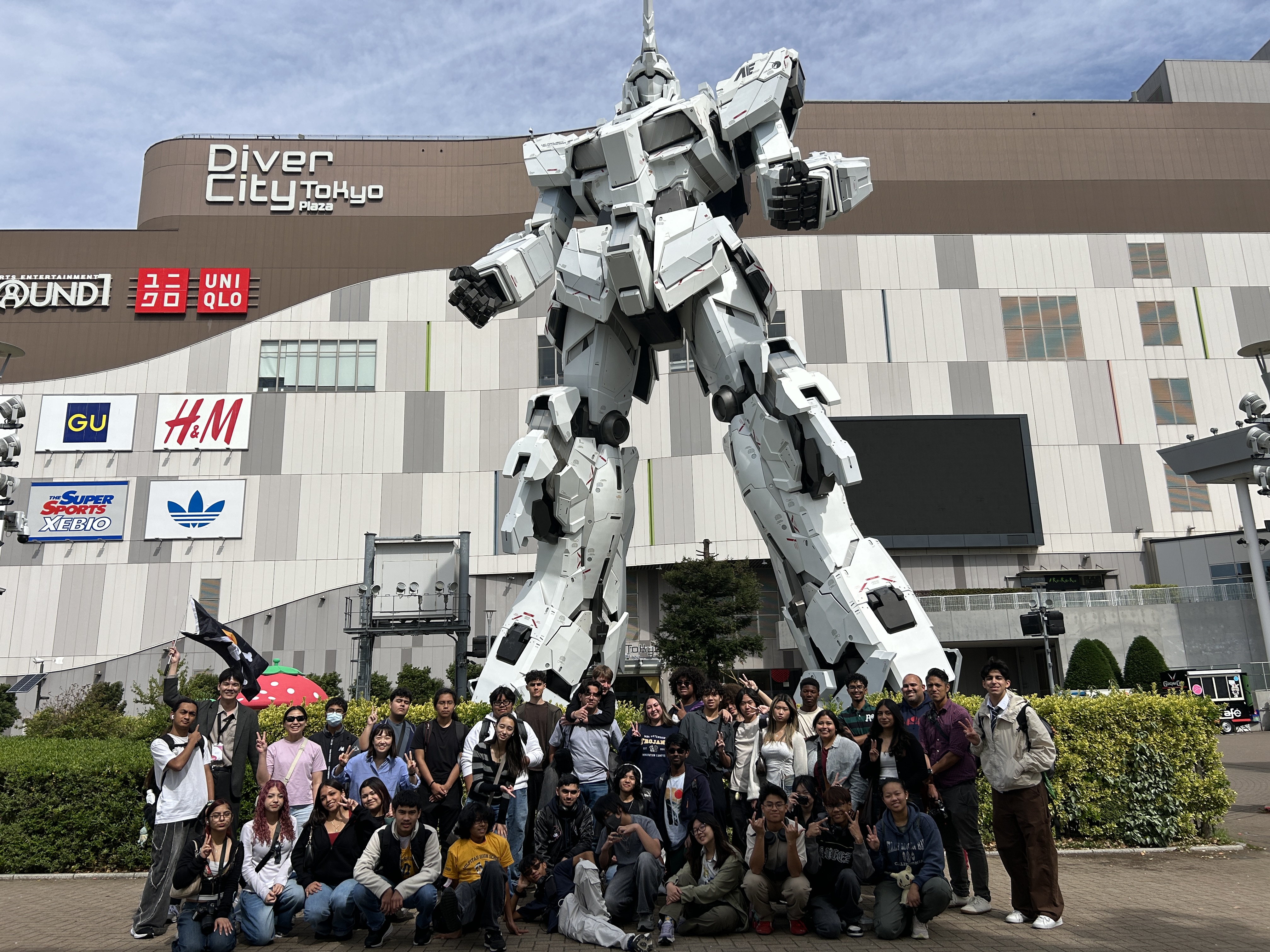
The students of the MHS Innovation Extension Campus went on a school trip to Tokyo, Japan, from April 8 to 16 during spring break, English teacher at the Innovation Extension campus Sejee Kim said.
Japan has numerous cutting-edge STEM-related opportunities that are not available for students in the U.S., Kim said.
“The theme of this whole trip was STEM experiences,” she said. “That’s why we found it in the first place. (The organizers wondered about) how they can bring more opportunities for students who don’t get these opportunities otherwise. E-tech and engineering (is about) encouraging people of color and girls into the STEM field.”
Tokyo was the main destination because most of the STEM-related attractions that students and staff wanted to see were there, Kim said. For example, the main attraction was the magnetic levitation bullet train (maglev) museum and exhibit, she added.
“We went to a disaster prevention park,” Kim said. “Then, we went on day trips outside of Tokyo, to Tsukuba, Japan, which is known as the Science City because they have the science square and the Institute of Industrial Science and Technology there.”
Students also got the opportunity to tour the Japan Aerospace Exploration Agency (JAXA) at the JAXA Tsukaba Space Center, similar to the U.S.’ NASA, sophomore Calvin Lam said.
“It was mainly about their rockets, seeing a lot of their older technology and how they got into space,” Lam said. “We got to see a couple of workers at the command center of Artemis II.”
Students had the opportunity to visit one of the world’s most advanced particle colliders (a machine that crashes particles into each other) in Tokyo as well as many other scientific exhibits, junior Long Nguyen said.
“There was one museum we went to, and there was a way (for students) to hold hydrogen,” Nguyen said. “(We) also saw a magnetic train that was faster than the bullet train that (the US) has.”
The students did not go to solely STEM exhibits and museums; they also spent a few days exploring and learning about the culture in Japan, Kim said.
“We also went to a tea ceremony, where they learned the different customs and practices of when you mix the matcha tea, which way you trick the bowl, and things like that,” Kim said.
The Japan trip was open to all current sophomores and juniors at the Innovation Extension Campus who were interested in going, Kim said.
“All the kids that were interested and super motivated signed up over the course of the past year and a half of our fundraising,” Kim said.
On its own, the trip would have cost $5,300 per student; however, students applied to a variety of grants and scholarships that allowed around 9 students to go for almost free, Kim said.
“One of the largest ones we got was from a Japanese-US nonprofit, a federation whose whole goal is to encourage cultural exchange between Japan and the U.S.,” she said. “So we applied for that and we got $20,000 right there.”
With the steep price, students had to find other ways of financing the trip’s costs, Lam said.
“Some businesses actually helped out with paying, like, if your parents work for Google or something, they would do an employer match,” he said. “I only had to pay $2,500 with that.”
The trip was extremely expensive, Lam said. However, it was worth it, he added.
“I would pay five grand just to do it again, but preferably for a longer time,” he said.
The trip was in the planning stage for almost two years—since the beginning of the Innovation Extension Campus, Kim said.
“It’s easy to plan a trip where everyone is willing to pay; that’s super easy,” she said. “The challenging part is trying to make it accessible for people that can’t afford it.”
Since the trip was limited to sophomores and juniors at the Innovation Extension Campus, current freshmen have been asking to go on another trip, Kim said.
“The planning, the fundraising, it was honestly a huge ordeal,” Kim said. “I’d like to (plan a new trip) maybe in a year or two, if we can get enough commitment for fundraising.”
The main reason for this trip was not just to explore STEM-related opportunities, but to expose students to what happens around the world, Kim said.
“Some of these kids never had the chance to travel internationally, and so it’s a good way to bring them up as a well-rounded citizen,” Kim said.
