
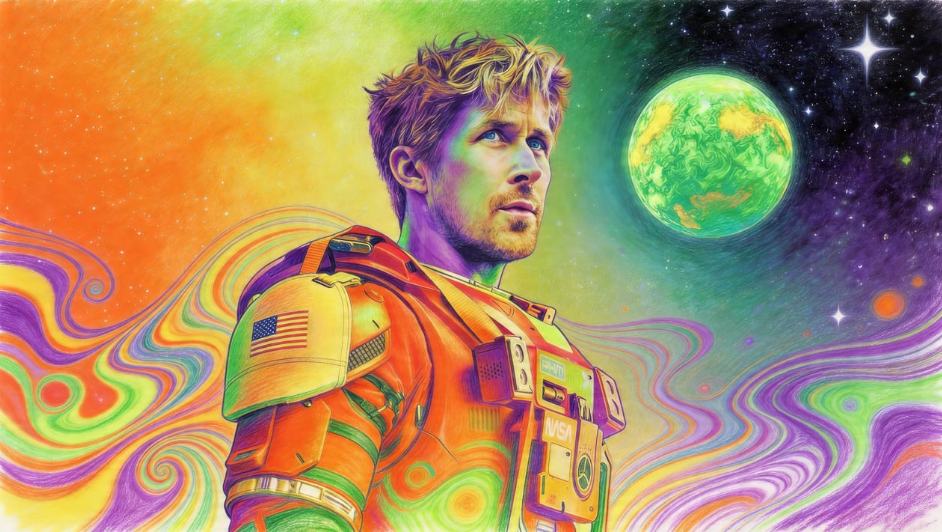
Rating (movie): 4.5/5
The groundbreaking “Project Hail Mary” movie, released earlier this year, is based on Andy Weir’s novel of the same name. The movie is both a heartwarming and heartbreaking drama of two individuals, one human and the other from an extraterrestrial species, as they both try to save their planets, and it beautifully captures the humanity at its best.
Andy Weir grew up in Milpitas, which brings a special sense of connection to the story, especially since he references the Bay Area in his novel. The movie, however, doesn’t hold the same connection, but it still remains largely faithful to the book itself.
However, there were a few key differences. For one, the movie felt as though it gave much less detail about how people were finding alternative ways to delay the effects of the sun’s dimming. Of course, a movie has limited time to address every small detail, but neglecting to mention that people melted some of the Antarctic and paved over the Sahara desert doesn’t show viewers just how desperate humanity was to save itself, so viewers may lack understanding of why Project Hail Mary was necessary or carried out the way it was.
The movie also simplified multiple scenes, which has the benefit of making the movie easier for all audiences to understand. I noticed that there was less of a “science” aspect to the movie, though the movie still does a good job explaining some important concepts, even with its limited timeframe.
Overall, though, the movie remained faithful to the novel, which I, and so many others, appreciate. While it is a longer movie, running at just over 2 and a half hours, every minute is worth it. The movie is visually stunning, and its eclectic soundtrack ties the whole movie together.
Despite being set in the vast emptiness of space, the movie is still full of color. While Rocky and Grace’s ships are made of drab xenonite and metal respectively, the universe itself is full of life, which adds a nice contrast to the scenes. Not only that, but all the scenes shown from outside the ships are simply beautiful. The scene where Rocky and Grace are collecting samples of astrophage is breathtakingly beautiful and has received well-deserved attention online by fans of both the movie and the book.
Additionally, the movie does an excellent job of playing with the lighting in different scenes. When Grace has to complete missions outside of his ship, the lighting becomes much harsher, just as it would in real life. The same goes for when Grace and Rocky meet in the tunnel; the darkness in those scenes adds a sense of realism and suspense to the movie. Each scene has unique lighting, which draws the viewer in and makes the entire movie feel more real.
The soundtrack adds emotional depth. While there are a few light-hearted scenes, the majority of the movie is hard-hitting and emotional. The soundtrack perfectly underscores the tense, dramatic moments and emphasizes the heart-wrenching ones. One key song that drives home the emotion is ‘Pō Atarua,” a Maori funeral song. The entire soundtrack draws from music from around the world, which helps focus the movie on humanity as a whole. After all, Project Hail Mary was meant to save humanity, not just a select few. By drawing inspiration from different cultures and time periods, the movie builds on the idea that we are all essentially the same, and we are all trying to do the best we can.
While this movie handles heavy, emotional topics, it does a good job of balancing them out with comedy. Rocky’s humor is the perfect type of Dad-joke, especially because he takes everything so literally. In the movie, Rocky is also given a “voice” that speaks human languages rather than melodic notes, as it was in the book.
The movie does an excellent job of bringing Rocky and his personality to life. Ryan Gosling, who plays the main character, Dr. Ryland Grace, also did an excellent job bringing his character to life. The subtle changes of expression that Gosling portrays reveal what Grace was feeling without any of the acting feeling over the top.
Overall, the film was a true masterpiece in terms of design, story, and acting. Both the movie and the book share a remarkable story of humanity; while people are never perfect—as the movie itself demonstrates—empathy for others is what makes us stronger.